

Oct 6, 2026
•
53 min
Time to cast off, scalawags. We're discussing The Pirate Queen by Ariel Lawhon and what it means to be a woman who refuses the life her world designed for her. We ask whether an ambitious structure pays off, what love and loyalty look like when your life is a bargaining chip, and whether the book's ending lives up to everything before it.

Kristy (00:02)
Hello, listeners. Welcome back to season five, episode seven of Books I Make My Husband Read. I'm your host, Kristy
Jon (00:09)
And I'm Jon the husband, currently still recovering from this particular book.
Kristy (00:15)
Well, this particular book is The Pirate Queen by Ariel Lawhon Now, if you listen to season one, you might recognize Ariel's name if you're already not familiar with her. She is the same author who wrote The Frozen River, which was absolutely one of my favorite conversations from that season. So this has been my most anticipated book of the year, and it did not disappoint.
Jon (00:39)
yeah, I was excited for this one too. I I enjoyed Frozen River and I like Pirates. So I thought this would be an interesting one, though I had no idea what this book was about. So yeah.
Kristy (00:50)
Well, why did I choose this book for Jon So if you've been following along, you know that one of our focuses this season was to read some new authors. So we started and ended with authors that we'd had already done before. So this is one of those authors. As I mentioned,
We did the frozen river in season one. It was one of my favorite episodes. This had been my most anticipated book. Jon really liked The Frozen River. And so I just made him read this one too. Bottom line. I wanted to read
Jon (01:18)
Bottom line. Yes.
Kristy (01:20)
it, so I made Jon read it. Yeah, all
Jon (01:22)
There it is.
Kristy (01:23)
that pomp and circumstance was like nothing. The real reason is I wanted to read it.
Jon (01:27)
Yep, and therefore henceforth I did too.
Kristy (01:31)
Henceforth books I make my husband read.
Jon (01:33)
Yes, yes, yes. A so a heads up. This is actually the final book of season five, which is crazy. We'll still have the season five recap, so don't worry about that. We'll have one more episode coming up before holiday break. And As Kristy mentioned, we did a
bunch of new authors, so we'd love to hear what you thought of these new authors and the books that we covered this year. So and you can do that by sliding into our DMs on Instagram. You can find us on YouTube. And of course you can always email us at books I make my husbandread at gmail dot com.
Kristy (02:08)
And of course if you are listening right now on Apple Podcasts or Spotify, please scroll down, tap the stars to rate and review. It takes fifteen seconds and it really does mean everything to us.
Jon (02:21)
Did you time yourself doing it?
Kristy (02:23)
No, I started to say 30, but I'm like, it's it's less than that. It's more than that
Jon (02:25)
It was probably a little lots of yes, yes.
Kristy (02:28)
if you write something, but if you've just tapped the stars, it's less than that.
Jon (02:33)
Yeah.
True story. Okay. So if this happens to be the first episode that you're catching of ours, this is the part of the episode where we give a spoiler free book summary. So we'll go over what this book is about without any spoilers. So you can decide if you want to keep listening.
Are you ready?
Kristy (02:49)
Let's do it.
The Pirate Queen is based on the real life of Gráinne Ní Mháille known to us as Grace O'Malley, a sixteenth century Irish clan leader, sea captain, and folk heroine who became so much of a thorn in the English crown side that she eventually sat down with Queen Elizabeth I herself to negotiate. Not a lot of women got that meeting. Grace O'Malley got it because she made herself impossible to ignore.
Jon (03:14)
So the book follows Grace across her entire life, from childhood on the wild west coast of Ireland through two marriages, motherhood, clan warfare, and decades of commanding ships and raiding cargo at sea. Lawhon structures it in three overlapping timelines Grace as the maiden, the mother, and the matriarch. Those three arcs are braided together throughout the book,
Jumping between them in a way the author herself has described as the Celtic Trinity Knot.
Kristy (03:43)
At the center of it all is a question that runs through every page. What does it mean to be a woman who refuses the life her world designed for her? Grace is her father's daughter in every way that matters. She belongs on the sea, she understands power, she's smarter than most of the men around her, and none of that counts for anything when she's 12 and can be married off to settle a political alliance.
Jon (04:06)
Her first husband, Donal O’Flaherty, is a volatile chieftain. her second, Richard Burke, however, is something else entirely. The English are encroaching, the clans are fracturing, yet Grace keeps sailing.
Kristy (04:21)
This is a big sweeping historical novel with a massive cast and a timeline that spans decades. It is not a quick read and it is not a simple one. But the story it's telling of a real woman who became a legend by refusing to disappear is absolutely worth it.
Jon (04:36)
Yes, it is. And if you find that it's worth it and you want to keep listening, it is about time to cast off. By the authority vested in me by absolutely nobody, I am granting you, our listeners, a full pardon. If you haven't yet finished the book, you are free to go. For the rest of you scallywags, spoilers start now.
Yes, I did.
Kristy (05:04)
'Cause you told me not to speak during that part. That was hard.
Jon (05:10)
Your face was frozen.
All right. So, spoiler territory. Let's talk about what we thought about this book.
Kristy (05:23)
Okay, here's where I am. You know this was my most anticipated book this year.
Jon (05:29)
I do.
Kristy (05:30)
So when the expectations are high.
Jon (05:34)
You can only be disappointed.
Kristy (05:36)
No, I mean, I don't feel like you can necessarily be just like always disappointed, but there's massive pressure, I would say. So I feel like the story itself, Grania's story, is a five-star subject. And I feel like Ariel Lawhon's research, her devotion to bringing Grace's story to life is a five-star effort. But
The way the book is structured through the three nonlinear timelines, braiding back and forth throughout, that was hard to follow at times. And you read the author's note? Okay. If you are listening, you haven't read the author's note. I hope you go back and read it or listen to it. But Ariel Lawhon herself acknowledges that
Or she she like what wrestled with really how to tell the story and it kind of came to her and she even suggests if you're going to go back and reread it, reread it in chronological order. And I saw some people online talking about that. I didn't read it that way. I r I read it how it is written. and I
respect that Ariel Lawhon chose to tell it and I think is what a more ambitious version and doing it that way and not doing it in chronological order. But I do feel like the book lost something in its readability. So I've been debating between giving it four and five stars because again, I love the story. But there were plenty of times I was pulled out of the story because I was like, wait, what year are we in? And I listened to it because I wanted to hear
the names pronounced correctly in Irish,
Jon (07:10)
Yeah.
Kristy (07:11)
which I think gave the book something extra for me instead of me like reading Niamh and going, There's no way that fucking spells Niamh
Jon (07:18)
Seriously.
Kristy (07:20)
or Gráinne for that matter, or any of the other th Eóin which we'll talk
Jon (07:24)
Yeah.
Kristy (07:24)
about. And I'm glad I listened to it, but there were times I had to pause it, look at the year
And see where I was and kind of reorient myself with okay, is she like married, who's she married to, where is she at in her life and her story? So it pulled me a little out of the story every now and then. But the story itself, man, what a wonderful, wonderful tale. Not tale. I mean, like I I I know it's rooted in history and obviously a lot of it is fictionalized, but what a wonderful, yeah, what a wonderful story.
Jon (07:57)
Yeah, I think I agree for the most part with that take. I I enjoyed the interweaving of the timelines. When I first started reading it though, I thought that they would eventually converge in the latest timeline and then that would be how the story finished. but you really keep that braid through the whole book. And yeah, there were there were a couple of times, but
Kristy (08:16)
you mean like
at one point in the book we would get to like a current place and then it would and then it would be chronological? Okay. I mean, because it does end with her last days.
Jon (08:24)
Yeah, because your each section she's getting a little bit older. Yeah, but like each section
she gets a little bit older, right? Her the her younger years and then her motherhood years and then her matriarch years. And so I thought at some point those were going to ultimately connect in the matriarch years and then we just finish that story out through
Kristy (08:45)
Yeah.
Jon (08:45)
her matriarchy and through the rest of her life. and it
It was a really interesting way to tell it in the in the author's note, she says she struggled with it telling the story like you mentioned, because she didn't want it to feel too episodic, which I thought was a really
Kristy (08:58)
Yeah.
Jon (08:59)
interesting way to think about it. And it probably would have come across that way because you would have had a jump so many years and yeah, like decades
Kristy (09:02)
Yeah, this happened, then this happened, then this happened. Yeah.
Jon (09:06)
ahead or whatever. And so I can see how that would have been challenging to decide how to write it. I I
Kristy (09:11)
Right.
Jon (09:11)
agree also it was a
Awesome story. I I loved her character. I loved the people around her. I loved Gutty and the Murray brothers and all these other supporting characters. she was a badass. And
Kristy (09:24)
Absolutely.
Jon (09:25)
yeah, I I told you actually I was maybe a a quarter of the way into it, and not that it's a parallel story by any means, but it immediately made me think of Braveheart for some reason, like just that.
Kristy (09:36)
I've never seen Braveheart. my god, you've never seen Braveheart! That's what
Jon (09:37)
Y You're not ready, right? I know I should just stop doing that.
Kristy (09:42)
Jon says every time he finds out I haven't seen some popular movie from a lot of decades. I mean, I hadn't
Jon (09:48)
From the nineties or any any decades.
Kristy (09:52)
seen The Godfather. we've
Jon (09:53)
Yeah. Yes.
Kristy (09:54)
been together in 15 years, and this continues to be something he does.
Jon (09:58)
This is true.
Anyway,
what made me think about Braveheart in the story was just like how the kind of leader that he was and and the kind of leader that Grace was, and like you had this unexpected, unlikely character to come into power and to kind of come into the this leadership position and and have the impact on our country the way that she did, similar to the way he did. And it really still makes me want to watch that movie. anyways.
Kristy (10:23)
One day
that all of what you're saying will make sense to me, but right now I just believe you.
Jon (10:27)
Yes, yes, just believe me.
so thoroughly enjoyed it. I think for me it was it was a five star read. the narration style aside, I love the the audio version. I would have had a much different experience of this book if I would have had to try to read it as opposed to listen to it. The narrator is Irish and so everything is like
Pronounced correctly, there's just like a whole different mood it brings to the narrative. And so I really enjoyed that. Fecking Yes. That's awesome.
Kristy (10:51)
Mm-hmm. Fecking Galway. I fecking is way
better than the word fucking, so I don't know why we don't use that anyway.
Jon (11:03)
Totally agree.
so anyways, let's get into the questions. I thoroughly enjoyed the book and let's dissect it a little bit.
Kristy (11:11)
Yeah. I I will say I just wanted to comment. I didn't want to interrupt you about the episodic piece that Ariel mentions in her author's note. It very much would have felt like that because as she mentions, like we don't have Grace's complete story because, like a lot of women in history, their story is not written down.
And so there's a lot of folklore that's out there about her. And she leaned heavily on that. But we don't get Grace's complete history. So lot of the book is fictionalized. But if she would have only written, you know, the true parts and added the fiction, it very much would have felt like this happened, then this happened, then this happened. And the way she does weave the story together is, I think, really smart. But again, it's it doesn't take away from the fact that it did pull me out of it sometimes. But also
all the authors out there, please put chapter numbers on your books. I'm sorry, just please put chapter
Jon (12:04)
seriously.
Kristy (12:05)
numbers. If you're buddy reading with someone, which we are a lot, 'cause we are a book club of two,
Jon (12:10)
Or book clubs and yeah.
Kristy (12:12)
put chapter numbers. Okay. That's like my small soapbox, but please.
What what chapter
are you in? I'm in s fifteen sixty three, yeah. You're right.
Jon (12:21)
fifteen sixty nine Grace is seventeen years old.
good times.
Kristy (12:29)
Okay.
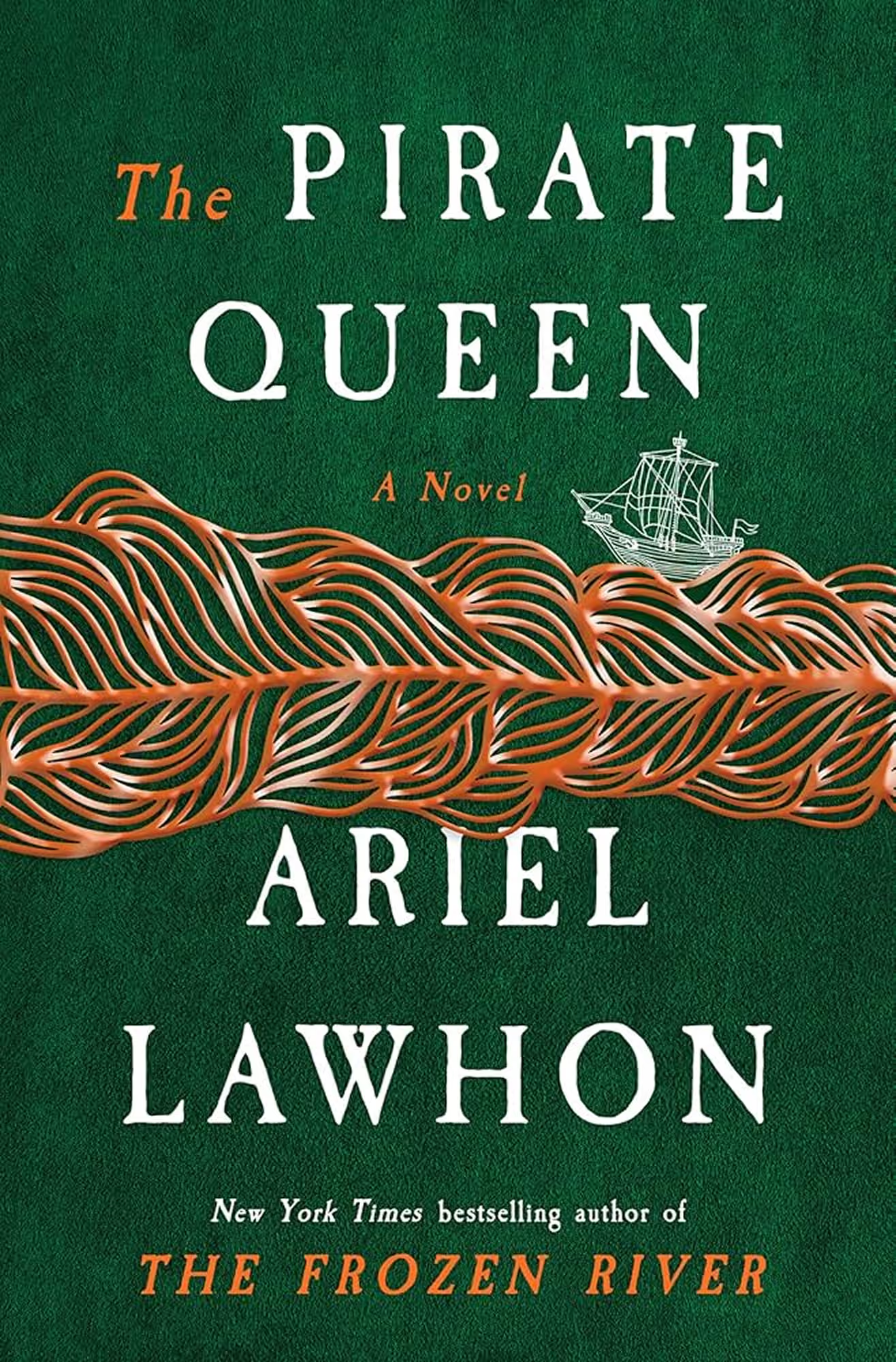
The book opens with five-year-old Grace cutting her braid off so she can sail with her father's fleet. That image, the braid, which is also on the cover of the book and quite lovely, comes back in the final pages. When you got to the end how did that land for you? I want to say, before you answer this question.
Jon (12:48)
answer the question.
Kristy (12:49)
no, I'm not gonna answer the question. You're free to answer the question first.
Something I just thought of when you were talking about what you thought of the book is how you were talking about the order of it. And the last chapter is Grace at the end.
she's in her 70s, she's in her final days, and she cuts her like long silver braid off. What if instead of it ending with her dying, really? The last chapter of the story would have been the first chapter of the story. Like, we hadn't heard that part about her cutting her hair off yet, and we got that part, like back to back.
Jon (13:23)
So it's bookending the book kind of, you know?
Kristy (13:25)
Yeah, so it actually
ends with her as a little girl and not I don't know, I just thought about that. That it
Jon (13:31)
Interesting.
Kristy (13:32)
again, this is kind of like Whistler, like of course it ends when s the story ends when someone dies, but like what if it doesn't?
Jon (13:37)
Yeah,
yeah, yeah, yeah. So what did I
Kristy (13:41)
Anyway, how did that all land for you?
Jon (13:44)
Me and metaphor s our relationship is
Kristy (13:47)
Complicated one.
Jon (13:49)
Complicated one. I figured it would have some kind of significance. It was a sign of rebellion. It was a sign of stubbornness. It it played a role in like just like visually describing her personality to some degree. I don't know that I caught any thread throughout the rest of the book.
with what it meant besides how the chapters were written, that they were literally braided together as well.
Kristy (14:18)
I mean I just thought it was like a nice way to end the book. A little cherry on top, a little nod to her younger self. I I did wanna say when she's younger and she cuts her hair out for the first time and then she remember she
has this thought, like, well, that was actually stupid. Why would I do that? I'm never gonna cut my hair. Even if like I didn't promise my mom I'm actually never gonna cut my hair again. And
Jon (14:42)
Yeah.
Kristy (14:42)
it makes me think all the times that I think I'm gonna cut my hair like a shorter length because typically I've had my hair mostly long my whole whole life or the majority of my life. But I have cut it and donated it. And a couple of times I've gone shorter
than I normally have. And I think that that's gonna be a good idea in literally every fecking time. I'm like, why did I do that? Did I never do that again? And actually within the last month I thought maybe I should like cut my hair, like shoulder length hair. Like I would look really cute. And then I'm like, no, don't do that. You will regret it.
Jon (15:19)
my goodness. that's funny. I actually miss my long hair too, for what it's worth. I was flashing back to a couple of old pictures from a handful of years ago. I was like I mean I
Kristy (15:32)
And our friend
Tim is growing his hair out. So actually I thought you might see him. When I saw
Jon (15:35)
That's probably what sparked it actually, yeah.
Kristy (15:38)
him, I was like, Jon's gonna wanna grow his out again. It
Jon (15:40)
Yeah. I don't think I have the patience for it, but yeah.
Kristy (15:44)
is a lot of work.
Jon (15:46)
For sure.
Kristy (15:47)
And I I will say like her hair is a theme throughout the book.
Jon (15:51)
Yeah.
Kristy (15:52)
I don't know, maybe it represents something. Maybe it's supposed to represent strength well, now that I'm thinking about it, there are times in the book where her hair represents her choice to defy what is normal. So like she cuts her hair in the beginning, front is it in front of the queen when she wears her hair down and
like someone makes a comment on it. So or
Jon (16:13)
I think so.
Kristy (16:14)
she r she calls it out maybe in her, you know, point of view, but I feel like there's several times when she talks about her hair and I wonder if I went back and reread it, if those times it would be like she's leaving it wild and, you know, there's reference to that. And if it's like this sign of like, I'm not going to
Jon (16:32)
who I am 'cause the reason she cut it in the first place was to so people on the ship wouldn't think she was a girl.
Kristy (16:39)
well, not really. I think it's like her dad just y her dad uses that. I don't think she wants to be
Jon (16:44)
Use a excuse.
Kristy (16:45)
a boy. I think she just wants to go sailing and she sees that as like the obstacle and it's just hair to her. But what I was
Jon (16:52)
Yeah, I didn't
Kristy (16:53)
what I was gonna say is she uses it to or is a sign of like her not falling to conventions or conforming to societal conventions.
Jon (17:03)
Makes sense.
Kristy (17:04)
I don't
know if that's true, but I would be interested to go back reread and maybe s suss that out.
Jon (17:10)
Sure, sure.
Kristy (17:11)
So Grace's father Eóin teaches her everything she knows about the sea and then arranges her marriage to a man she doesn't choose. He loves her and he uses her in the same breath. How did you read that relationship?
Jon (17:24)
felt pretty much on point for the time.
I I don't think those two things are mutually exclusive that you care for someone but
he didn't know how to do it any differently, he's still a chieftain. There's still alliances he has to create and at the time marrying off a daughter is part of how that strategy was executed. So yeah, I mean I'm not
You know, sit here and debate that, you know, women shouldn't be married off or anything like that, 'cause this was the fifteen hundreds and that was the time and something.
Kristy (17:52)
I mean they still shouldn't. Shouldn't have been. I mean she
was treated like property.
Jon (17:58)
I get it. I get it. But I'm not going to like say that was so awful of them back then when that was
Kristy (18:06)
It was awful though. Like you can say it's you can say I understand that was the norm, but you can still say it was awful.
Jon (18:13)
Yeah, that's fair. That's fair.
Kristy (18:15)
Unless you don't think it was awful, then like maybe we should end the podcast right now. Have a different discussion.
Jon (18:23)
But Yeah, no.
I it it is. I I mean I you kn you know that. but anyway, I d I don't know if that's what you meant with this question or not, but
Kristy (18:34)
Well, I think I mean I think the point of the question is like it is crazy the things that society thought was fecking normal then, cause it was like you're you're saying it, like that was completely commonplace. the person she marries is gonna get a large dowry and then
Her dad gets like the fleet of ships. And so she's like really being married off as property. And that's horrible. It's normal then, but it was fucking horrible. it's awful that you can look at your daughter and love her and I don't know, respect her in some way, but also like treat her like she's property. It's crazy to me.
Jon (19:16)
I get it.
Kristy (19:17)
Let's talk about Grace's mother, though, who didn't to me get enough time on the pages. I wish she would have had more time.
Jon (19:23)
Hm. I agree with that.
Kristy (19:27)
Cause I liked her character. And I think she tried to be the voice of reason with Grace a little bit, I feel like she wanted her daughter to be her own woman, but she also recognized, you know.
quote unquote, again, not agreeing with the duties that her daughter had or would need to fulfill, but she very much wanted good things for her daughter. But
says early on in the book,
and she says this to Grace, I think in the first chapter, right after Grace cuts her braid off for the first time, Men will never respect you if you try to be like them. Do you feel like Grace heeded that advice and did it hold up as true across her life?
Jon (20:08)
Mm.
I think she did. I think she heeded that advice. I never got the sense that she was trying to act or be like a man. I think she was just following her own heart and passion and desires and doing it in the only way that she knew how. She wasn't trying to replicate how a man would do it, albeit she had to do things that at the time were traditionally
Men were only doing done by men, yeah. leading ships, pirating, murder.
Kristy (20:36)
melting lead and pouring it on people which
Jon (20:39)
Yeah, that
Kristy (20:40)
was which is true. Like that was something that yeah, factual pieces, yep.
Jon (20:43)
one of the factual pieces that she found. Yeah.
Yeah. So I I think she did heat it in her own in her own unique way. what do you think?
Kristy (20:53)
Yeah, I think if you didn't sit with this one, you would think differently. You would say, Well, her mom said that, but then Grace spent the entire book trying to act like a man. But we only think that, or people only think that, because those were the opportunities given to young boys and men at the time. They weren't expected of women. Like when she goes off for her
Jon (21:16)
Fostering
Kristy (21:16)
Fostering.
I was like, what do they call it? Tutelage?
Jon (21:19)
Yeah.
Kristy (21:20)
When she goes off for her fostering, she's like taught how to run a household, how to like take care of children, or like all the things that you would when you think of like a traditional woman in that time period that's what she's learning. Meanwhile, her brother is learning to fight and write, yeah,
Jon (21:37)
Ride horses and
Kristy (21:38)
do like manly things. So
at the time, like those things are not expected as women. So you would say she spent her life trying to be like a man, but I think your point is right. Like she just spent her time doing what she wanted to do. And it only seemed like it was a man because men were the only ones allowed to do that.
Jon (21:59)
I think so too.
Kristy (22:00)
So Grace and her brother Donal are each other's anchors their entire life. How did their dynamic hold up across the three timelines? Were there moments where it got complicated?
Jon (22:09)
I don't think so. I
I think very early on there was a very clear connection between the two of them. They supported one another as children. Donal took his father's advice of always keep an eye Gráinne know, at all times. I think he took that to heart. And that really drove him, I think, through his whole his whole adult life. I think early on they agreed that.
they could mutually benefit from one another's strengths,
and roles that they would have to play in their adult life. and I think the moment when he had to protect her
when she was about to get assaulted, sexually assaulted, and he had to come
Kristy (22:46)
Mm-hmm.
Jon (22:47)
save her. And the first time he killed a man was that time. I
Kristy (22:50)
Yeah.
Jon (22:50)
think that really instilled in him something a protection and love for her that was deep and stayed with him through their whole life. I don't know of any complications, or I can't think of any complications besides the fact of like he as the older
sibling and as the boy in that family was meant to be the chieftain, lead the ships, or command the ships. and that fell to Gráinne but he never wanted that anyways. And so I think he was okay with that
Kristy (23:17)
Yeah.
Jon (23:17)
in the story anyways. I don't know. What was your take?
Kristy (23:20)
I mean, I think I agree with what you're saying. I think there were times it could have gotten complicated and because they had built a really great bond, it didn't. even as a young girl, I mean, her mother had this distaste for Donal because her
Jon (23:36)
Was a bastard.
Kristy (23:37)
they're half they're half siblings and her father had
Donal before he married Grace's mom.
Jon (23:43)
Maeve
Kristy (23:44)
So because Grace's mom treated Donal a certain way and Donal's mom treated Grace a certain way, like you could understand how she could have probably felt similar thought, I'm better than, you know, you because my dad is like the chieftain and my mom is you know,
Jon (24:00)
Wife.
Kristy (24:00)
wife. And I'm their bio you know, I'm both their biological daughters and they're the ones in power. So
You could have seen that, but they're just kids, and that was just her brother, and she loved him, and she there was no one at that time that she felt more fondly for. And so it was it was really special that they had that because it did lead to, I think what you're saying, it allowed him to be who he wanted to be and be chieftain in like name, but allow her to do what she wanted to do that she probably wouldn't have been able to do otherwise because she was a woman.
wouldn't have been voted to. She could have done it, 'cause she did. Be be clear.
Jon (24:38)
She did. She done it.
Kristy (24:42)
While you read about Eóin O'Malley's calculated plans for his daughter's marriage, Walter Burke versus Donal O'Flaherty, did you see any wisdom in the chieftain system or was it entirely oppressive? Would you have enjoyed living under Brehon Law?
And testing the waters with a trial marriage. And you already know I added this question.
Jon (25:05)
I don't want to be recorded answering this question. just kidding. So what do I think of the trial mar what do I think of a trial marriage? Is that the root of this question?
Kristy (25:14)
Well, it was like, do
you think as her father was making the choice between the suitors? Do you feel like or did you see any wisdom in that system? Like, this is actually smart. We should do this, or do you feel like it's entirely oppressive? And then also
What did you think about the Brehon Law?
Jon (25:34)
lacing a lot of questions into one. I think
Kristy (25:38)
Would you like to only answer one of them? Choose your own adventure.
Jon (25:38)
I well I mean
the first part of like yeah it probably is a a slice of oppressive and while also strategic. Like
Kristy (25:52)
Yeah.
Jon (25:53)
I don't think those can be mutually exclusive given the the time. think he may have been more open to an alternate
choice if she hadn't pissed him off so royally right around that time. I don't remember exactly what she did, but basically it sort of forced him to say, Okay, O’Flaherty's gonna be the suitor for you. I don't remember exactly why you're giving me that look.
Kristy (26:16)
Because like, my daughter who's sixteen years old makes me mad, which I don't even remember, but makes me mad and I'm gonna make her like marry someone that she says I don't want to. No. Well, she shouldn't have to.
Jon (26:29)
Well, she didn't want to marry either of them, so there is that. I'm
not arguing that point. That's not what
Kristy (26:35)
Ha ha ha.
Jon (26:35)
this book is about.
Kristy (26:37)
I think it is entirely oppressive. However, there could be some like advantages as long as the two people are willing. They might say, like, I don't like love you, I don't love you, but I don't like hate you enough. We could join together and have an alliance.
I would like to make an alliance with you.
Jon (26:59)
I see. And then do it on a trial basis to see if the alliance holds
Kristy (27:02)
Yeah, now
Jon (27:03)
up.
Kristy (27:03)
let's see what's up. What did you think about Brown Law?
Jon (27:07)
I think for their circumstance it made a lot of sense. I think trial marriages in general could make a lot of sense, though in the book it was for one year and one day only. And I think we all know that any marriage, almost any marriage, the first year is you're in the honeymoon phase. And so of course by the end of that year, you're gonna be like, This is great. This is totally gonna last. It's I don't think it's a realistic amount of time
Kristy (27:32)
Okay, let's just say it's a trial marriage. Like let's not tie a length of time onto it.
Jon (27:37)
Well that's w that we're talking about the book though, right? And the book there is a length of time.
Kristy (27:41)
The question is, what do you think about testing the waters with a trial marriage?
Jon (27:47)
That's what dating's for.
Kristy (27:49)
Okay, no, dating is not the same as being married. It's not. Some people don't even live together before they're married, which I think is cuckoo bananas, but it's true.
Jon (27:58)
I know, I know.
Kristy (28:00)
I think if we looked at statistics for the United States, like 50% of marriages end in divorce. Like that's I'm pr I'm pretty sure
Jon (28:08)
Probably higher than that, but yes.
Kristy (28:09)
it's like 50%. Okay. Let's look at the 50% of people who get divorced. Like, at what year do they get divorced? I I'd say if it's within the first three years, then like, hey, let's have an option that you could have a trial marriage and
Whatever you entered in with, that's what you leave with. seems totally reasonable to me. when she first says Brion marriage, I was like, I don't know what that is. And when we learn what it is, I was like, that is so smart.
This needs to be instituted.
Jon (28:40)
way past the statute of those limitations, so
Kristy (28:42)
I'm happy with our marriage.
This has nothing to do with our marriage, but there are people who get into marriages and feel like they can't get out of them. And if they just dissolved, it would be much easier.
I also think you should have to just like renew your marriage. Like after seven years you have to be like, Yeah, let's do another seven. Why not?
Jon (29:03)
Okay, that one's new. Let's move along.
Kristy (29:05)
No, it's not. We literally have talked
about this.
You have nothing to worry
Jon (29:10)
my goodness.
Kristy (29:11)
about. Like we're hitting the second seven. I'm ready for another seven.
Jon (29:15)
Okay, yes, let's go.
Kristy (29:18)
So speaking of marriages, there are two in this book for Grace.
Donal O’Flaherty who was her arranged marriage and ends up being a super big butthead. And then Richard Burke, who becomes something of a true partner.
What do those two relationships say about what love and loyalty actually looked like for a woman in Grace's position?
Jon (29:39)
I think the f first is probably more common for that time period to your point about women being looked at and viewed at solely as property, no real individual rights or anything like that.
Donal yeah, Butthead but then contrast that with Richard and someone who, even from a very young age, when they were introduced in fostering, teaching her, respecting her, seeing that she was.
Different and approached that with curiosity and interest,
know, from a very young age was teaching her how to fight with a knife or how to defend herself in general, even against his own older brother, Walter. so it was a very polar opposite dynamic and it really goes to show the impact a partner can have, someone who is
Oppressive and someone who puts you down versus someone who supports you and empowers you to be who you are. And the outcomes of that would have been or could have been very different, if Donal hadn't died in the way he did. So know. Does that answer your question? What your thoughts on this question?
Kristy (30:49)
I feel like what you're saying about someone who can hold you back or empower you is no different than any relationship in partnership, you know, t in today's world that
Jon (30:59)
Agreed.
Kristy (31:00)
if you
Have someone supporting you and
seeing you through a lens that like you see your true self, or seeing you in a lens that maybe you don't see yourself, but can empower you to reach a potential you didn't know you had versus someone who makes you feel a certain way or holds you back from like what you want to do or tells you what you're supposed to be. mean, that was like the difference in the two relationships. I feel like
once Donal died, mean, she was shedding all the things that held her back when she was married to him. But really, the reason she marries a second time
It is for an alliance in some ways. Like now they had history and like all those things, and they end up having love and a true partnership. And there's there's a lot of layers there, which you won't totally get into, but like I think it really was for the alliance, at least the story we get is for the alliance. So in a lot of ways, there is a lot of strategy
Jon (31:59)
Mm-hmm.
Kristy (32:00)
for the second marriage as well as a first marriage. But the difference was is this time it was her choice.
Jon (32:06)
Her choice.
Yeah.
Kristy (32:07)
And that's why she opts for the Brehon marriage because she's like, I'm not going to have someone else take my choice away from me.
Jon (32:15)
Yeah, great point. Solid.
Kristy (32:17)
So Tibbot,
Grace's son, who she has with Richard, is born at sea during a storm on the ship Niamh. What did you make of that scene and of Tibbot as a character overall?
Jon (32:27)
I couldn't not think of the scene in the Handmaid's Tale when she gives birth it at the cabin, the house or wherever she is. Yes.
Kristy (32:32)
At the ca or the house by ourselves, yeah.
Jon (32:35)
And that's all I could imagine. Like that's fucking that's becking awful.
Kristy (32:38)
Ha ha ha.
Jon (32:40)
but I think it speaks just volumes to the type of woman that she is, the strength of a woman that she is, and that then e after immediately giving birth and tying the cord, she walks out all bloody from that and blasts the head off this pirate captain that's boarded her ship and the rest of history.
Kristy (33:02)
The rest actually
is history because that is w something that is recorded is true.
Jon (33:06)
It was recorded as factual, yeah.
Kristy (33:08)
if you didn't think Gráinne Niwala
was a badass, you do now.
Jon (33:12)
Yeah. So that that's what I thought of during that scene. And challenge and just like the exhaustion and even in the author's note, Ariel was like, I couldn't even get up and walk to the bathroom by myself when I after giving birth. And so
Kristy (33:25)
Right.
Jon (33:26)
as far Tibbot goes, feel a little bit same way as I feel about Maeve
Kristy (33:31)
Maeve
Jon (33:32)
Like I don't think he got enough page time.
seemingly played a a role, you know, towards the end. he was just kind of there. He didn't really get any of his story. He was born and we got that and then he was like taken from her later on in life. And so I don't have an opinion of Tibbot as an individual because I don't think he got that much time on on
Kristy (33:53)
Yeah.
Jon (33:54)
the pages. So unless I'm missing something which is entirely plausible.
Kristy (33:57)
No, not not at all. But I do agree with you on that scene. Like that was badass. And then again, as you're reading historical fiction novel, you know a lot of it or some of it to the extent that the author has taken the liberties. And some authors are very fictionalized and some try to really stay as true the story as they can. And obviously they cannot be in the room hundreds of years ago and have conversations.
But they spend a lot of time researching these characters. And feel like when you're reading the novel, you're like, did this really happen? Like, or is this one of those fictionalized portions of it? And
I mean, if you're like me, you're constantly asking yourself about that and wondering what you're going to go research yourself later because that's what I do. And when I found out that was real, I'm like, that's fucking badass. It was badass when I thought it was fictional, but it's even more badassery.
'Cause it really happened. Also,
Jon (34:51)
Yeah.
Kristy (34:52)
what the fuck is léine?
Jon (34:54)
I assume like a nightgown or like an an underscore. I know they say it a lot. It's basically like it's pajamas. Pajamas.
Kristy (34:58)
They say léine a lot. Yes.
I'm like, is this her like bra? Or but it's more it's obviously more than a bra, but it's like undergarments, I'm guessing.
Jon (35:07)
I Yeah. It's an
an undergarment. The way I pictured it is like just like a a very light cotton undergarment that you can put anything over the top of and yeah. PJs of the fifteen hundreds.
Kristy (35:20)
It was just funny. Yeah. Please hand me
my léine Tibbot's character, I agree with you. I feel like he didn't get enough time on the pages, but I do feel like the little we get, there's a distinct difference between the loyalty that he has for his mother versus the loyalty that her other three children that she had with Donal have for her. And I don't know if
Jon (35:42)
I would agree with that.
Kristy (35:43)
that is
Because of the relationship that she had with Richard or a
Jon (35:47)
Yeah.
Kristy (35:48)
number of things, but and we don't really get her oldest son Eóin dies as a young man and then fairly early on in the story as well. So we don't see that relationship, but she says, like all my children have left me in one way or another. At that point,
Jon (36:02)
Yeah.
Kristy (36:02)
she doesn't have Tibbot.
Jon (36:03)
Right, right, right. Yeah. her oldest Eóin was murdered by Bingham, right? Yeah. And then
Kristy (36:08)
Bingham. Yeah. Fucking bing
Jon (36:12)
I think her she still had a decent relationship with her daughter, but it w it was close. It it was but it w it
Kristy (36:17)
Yeah. don't think her daughter
had animosity toward her like Merrick does and she didn't her daughter doesn't like betray her, but I'm
Jon (36:21)
Merrick did. Yeah, that's what I was just gonna say, yeah. Yeah.
Kristy (36:25)
sure her daughter was married off young and that
Jon (36:27)
Right.
Kristy (36:28)
was it.
Jon (36:28)
Yep.
Kristy (36:30)
Alright, so speaking of Richard Bingham, Grace's good heart, the way she wins loyal followers like Gutty and the Murray twins, is one of her greatest assets, but it also puts her at risk against enemies like Sir Richard Bingham, who has no such limitation. Did you ever feel like her decency was working against her?
Jon (36:49)
No. I don't think so. I don't think it was her decency that worked against her. I think it was the fact that she was a woman. I think her good heartedness and her fairness is what made her a great leader and is what made people want to follow her and fight for her. And Gutty and the Murray brothers are awesome characters. I
I love them throughout the whole story.
Kristy (37:08)
It's so funny to hear you say Murray brothers because they're only referred to as the Murray twins in the book. And you said that
Jon (37:13)
Twins, yeah, yeah, that's true. That's true.
Kristy (37:16)
and I'm like, that's not r I mean, it is right, but I in my head I'm like, that's not right.
Jon (37:19)
Yeah,
you're right. The twins, that's right.
Or the memes?
Kristy (37:22)
Finn. They're both were named Finn, but she called them Finn and Murphy, right? Because she she couldn't, she's like, Why are you both named Finn? And she's they're my our mom thought it was just easier because she couldn't tell us apart. So she's like, I'm giving you different names.
Jon (37:28)
yeah, because she couldn't that's right. my god, that's right. Tell us apart. That's right. Totally forgot about
that. Yeah, okay. and so the one she called Finn wa had been in love with her for a very long time. And so that was just a
a very interesting dynamic and
played a role in his continued support for her and had to have just been so frustrating at times for him, like that one chapter or moment in the book where she saves the sailor from the sea and he's all pissed because he thinks he's all shady. He winds up is kind of all shady. But
Kristy (38:07)
yeah.
Jon (38:07)
the only interest she had in him was a physical one and or a strategic one. And he's all like
pissy about it. but it was what was cool was like she was the kind of leader that would have those sort of close confidants that could tell her those sort of things and without the fear of being, beheaded or put in prison or whatever. So I
Kristy (38:27)
Off with your head.
Jon (38:29)
liked yeah. I just liked her leadership
style, I guess, for lack of a better phrase. So do you what did you think? Do you think her good heart or decency worked against her or became a weakness of any kind?
Kristy (38:42)
Think it was a weakness because that would mean that being decent is probably bad or bad at times. And I don't think you can ever be too decent. I think that not being decent, in the face of people who don't deserve your decency, says more about you than it does about them. So I think
what you're calling out and naming is right that at times when it worked against her, it wasn't her decency, it was her being a woman. But I also think that had she been a little more ruthless at times, she probably would have faced less adversity. But again, I don't think that would have been her being true to herself. That would have been her trying to be like everybody else. And that's not who she was.
Jon (39:25)
Yeah, I think that's something a style Donal O’Flaherty would have taken
Kristy (39:29)
Right, exactly.
Jon (39:31)
and not her father her father taught her more of that sort of like more the Mufasa style of leadership where you know he was brave and violent only when he needed to, not at all times or whatever.
Kristy (39:44)
Yeah.
All right, we touched on this a little bit, but I didn't get your thoughts. So the Trinity knot structure, the three timelines braided together, it does something really, I feel like ambitious in the book. Did that work for you as a reader? Because we already talked about me. And do you feel like it also made the book harder to stay in, which was my thoughts.
Jon (40:05)
I I liked it. I at least I liked it for probably the first two thirds of the book. And as it got it was yes, yes,
Kristy (40:12)
You until you realize it wasn't gonna converge like you wanted.
Jon (40:15)
exactly. Curses. and then I was like, okay. And then yeah, there were times where especially when the age gaps were closing a little bit more, or the difference between age forty four Grace and age sixty three Grace, like she was already sort of in that matriarch.
phase, but it was still a mother chapter. And so the lines were blurred. And yeah, I did find myself a couple of times just double checking the chapter of like what year was this or how old is she right now? but upon reflection, I I enjoyed the way that that was written. I think if it would have been written in a linear fashion as she even calls out herself in the author's note, it would have been a completely different read. And
I think maybe I liked about the way that she did it was she would plant something in like, know, the matriarch or or motherhood channel, and then she would connect it like when was first introduced to somebody or when a moment happened that she rejected reflected upon what was the origination of that moment back in the childhood years. I I'm trying to think of an example. I guess for an example of like Bingham, her hatred for
For Bingham. Like you you he's a bad guy, but then you learn in the younger chapters of I realize this is the part that she fictionalized a little bit because there's no document historical record of when they actually met, but she chose to for them to meet as children, and
Kristy (41:27)
Mm. Yeah.
Jon (41:29)
there is like an immediate disdain and dislike for personality
Kristy (41:32)
Yeah.
Jon (41:32)
types. And so I liked how that sort of give and take and it helped you sort of close the loop on these things. but I do think it it possibly
soften some of the drama or some
Kristy (41:44)
Mm.
Jon (41:44)
of the tension could have continued to build over the course of a life in a linear fashion as opposed to tension in this moment, throwback to childhood, back and forth. So
Kristy (41:56)
Yeah.
Jon (41:56)
think that that's my take on the the interwoven timelines.
Kristy (42:00)
I think those are really great points that maybe the tension was softened or don't know, like it I don't feel like there was anything like shocking and surprising about the story, but a lot of the as you're saying, like the characters appear in multiple timelines. So you don't have to wonder who this person is, but a lot of times we're getting them when they're older.
And then we get the first meeting like later on in the book, but earlier on in her life.
Jon (42:24)
Earlier in their life, yeah.
Kristy (42:26)
But one thing that I thought maybe this is, I don't want to say confusing, but pulled me out of again when I say I was like pulled out of the story and had to like see where we were in in years, is the three are maiden mother matriarch, but the mother chapters, she's not rearing her children. I mean, her child
her children are at points in that story like grown.
Jon (42:50)
Or have gone off to fostering themselves and so yeah.
Kristy (42:52)
Right. So
sometimes it like felt like the later mother chapters and the matriarch chapters were in my head maybe a little the same. And that's maybe where I was going, okay, where are we in the timeline? But
Jon (43:04)
Yeah.
Kristy (43:05)
I mean, again, we do get some of those. So I don't want anyone go like, Yeah, we do, but the we also get a lot later on too.
Jon (43:11)
Yep. I agree with that.
Kristy (43:12)
Again, I I really enjoyed the story and I think that the way the author chose to write it was really smart. It doesn't also it like both can be true that it was difficult to read at times because I had her reorient myself, but it was also really smart that she did this because like to your point, maybe some of the other things we felt would we wouldn't have if it would just been this linear story.
All right, the meeting between Grace and Elizabeth the First is the book's climax.
Two women who built kingdoms inside systems designed to exclude them sitting across the table from each other. the way Lawhon wrote that scene live up to everything that came before it? And noting this is a true story, this is one of the most recorded things about Gráinne's life and what is known as the 18 Derogatories, the letter that Queen Elizabeth wrote to
Gráinne and asked her these eighteen questions.
Jon (44:06)
yes, to answer the question, I think it definitely lived up to the expectations. I thought the scene was just a battle of intellect and like a battle of words, but not really a battle like the battle was Grace trying to not gain an understanding but showcase
That they weren't that dissimilar, even though she was obviously royalty and she was a pirate and blah blah blah.
Kristy (44:30)
Privateer.
Jon (44:31)
Pri that it was like the fact that the Queen spoke in Latin to her and that they could have like this whole conversation in in Latin was just something
very smart and
Cunning, but not in like a not in the negative connotations that word often gets used alongside. was awesome. I I kind of wish I could see it on a film, actually. I feel like this book would be awesome on a film. again, I I'm drawing a correlation to Braveheart in my mind too a little bit too.
Anyways, I don't really ha have any words. I I I enjoyed that scene. I thought it was great climax to the book. It was really everything her whole life coming sort of to a culmination of everything she's fought for for herself and wanting that recognition, maybe,
from someone of authority that
Kristy (45:23)
Acknowledgement.
Jon (45:24)
acknowledgement that this is hers, she's earned it,
yada yada. So tell me your thoughts on this scene.
Kristy (45:32)
I agree with what you're saying. And it's so funny. After I read this question, the first thing I thought of was just like just now, huh? No.
Jon (45:40)
Braveheart. Braveheart
Kristy (45:44)
Again. After I read the question, just now before you answered, the first thing I thought of was, I cannot wait to see this on film and this like meeting that's gonna happen between these two people. But
You're right. It's it's this amazing scene in the book, and what it all is, you know, moving to and culminating to. And you have these two women to these two powerful women who beyond all odds have kept their power in different ways, but have kept their power in a I wanna say at that time man dominated world, but who are we fucking kidding?
That even more male-dominated world. And Queen Elizabeth was in power, it was queen for a very long, I think like 50 years or something like that. So they and in Gráinne as well. I mean, she has been, you know, pseudo-chieftain for a really long time. And so they're in this room, and like you say, they're speaking Latin and other people can't understand what they're saying, and they're just having this private conversation.
among a r a room of men. Yeah, it
Jon (46:47)
Room of men, yeah.
Kristy (46:49)
it was really powerful and you know, Gráinne's point, like we're not as dissimilar as you might think we are.
Jon (46:55)
And there was like a good tension there too. It wasn't just these two women meeting and of course they were going to align because they're the only two women in the in their circumstance, but like she was she had a bounty on Grace had a bounty on her head, right? Like
Kristy (47:10)
Mm.
Jon (47:11)
Queen for many years saw her as a threat to
Kristy (47:14)
Yeah.
Jon (47:14)
England and so
the real tension to show up in person. it wasn't nothing was guaranteed in that meeting. And so and you could could feel that tension in the dialogue of that conversation even as well. It was a very much a game of chess with words.
Kristy (47:29)
Yeah.
yeah. the queen is very smart and very calculated in her own right. Again, we don't get her on the pages, but that is the way she's presented in that scene and presented at small moments in the book. And
if memory serves me right, also a queen that had her own cousin beheaded.
Jon (47:46)
There w that was yeah, that was brought up in the book. Yep. cousin or
Kristy (47:49)
Mary Queen of Scots, right?
either way, had done some ruthless things or agreed to allow some ruthless things to be done. So she's very calculated in her in her own way. And like you said, it was a game of chess between the two of them. And like coming to this, I will say, understanding.
And I love the part when Gráinne does not kneel before the queen like everybody else does. when when they first meet, And she says at the end, because I feel like Grace wants to show her some type of respect to acknowledge that they have come to an agreement.
I felt like she kinda wanted to do it, but she said she felt like the queen would have disrespected her more if she did. And
Jon (48:30)
Yeah.
Kristy (48:30)
so she chose to still not curtsy and just like leave with her head held high.
Jon (48:35)
Yeah. was like a subtle nod or like a an acknowledgement, but yeah, I I
Kristy (48:37)
Yeah. Yeah,
that we're like we're both in positions of power and I don't have a title like you do that's been formally given to me, but we are both powerful in our own right.
Jon (48:49)
Yeah, I like that part too. That stood out.
Kristy (48:52)
All right, well, your absolute favorite question of any episode, do you have any final thoughts? And would you recommend the Pirate Queen to our listeners?
Jon (49:01)
No final thoughts actually for this one, even though I did I feel like I have had a couple in the last few episodes.
Kristy (49:07)
You have.
Shocking. Guess this one's not gonna be a banger.
Jon (49:12)
would recommend it. It is a really, really good story. And a character driven book that still has through line. And so
Kristy (49:23)
It is a character driven book.
Jon (49:26)
very much enjoyed book. so thanks for shoving it in my face.
Kristy (49:30)
You were welcome. I have that on recording that you were thanking me for making you read a book.
Jon (49:35)
Just this one. Just
just one. This is one. that's not true.
I'd be curious, like I n I don't reread books. I don't have time to reread books, but it
It would be interesting
to reread this one in chronological order and
Kristy (49:49)
Yes.
Jon (49:49)
see what the reading experience would be like, especially since the author herself calls it out
Kristy (49:54)
Yeah.
Jon (49:54)
it's I actually thought it was funny. She's like, This doesn't strike me as a book that people would want to read twice.
Kristy (49:59)
Ha ha
Jon (50:01)
so I thought that was cute. But anyway, yeah, what are your final thoughts?
Kristy (50:04)
I don't know that I have anything extra to add on our conversational chapters, but I would absolutely recommend this to our listeners. Definitely if you are into historical fiction already, this is a good one. If you are into historical fiction that is maybe in a time period that you're not used to seeing, if you're into books that have strong female leads, if you are into a very unique story.
I think that you would really like this.
It's not like anything I've ever read.
Jon (50:35)
I agree.
Kristy (50:36)
All right, so that is a wrap on all the books that we are going to discuss for season five. We will have a recap episode for you in two weeks. and on that episode, we'll be looking back at all seven books that we read and letting you know how we felt about them. That episode will be spoiler free. So if you haven't read, if you've listened to maybe some episodes because you read the book, but you haven't listened to others because you haven't had a chance to read that book.
No worries, there will be no spoilers. But don't forget that if you have a thought or something you want to share about the show or about our reading selections, or you have an idea for season six, you can find us on Instagram or YouTube, or you can email us the old-fashioned way at books I make my husband read at gmail.com.
Jon (51:21)
Like a rotary phone, the old fashioned way.
Kristy (51:23)
I it really i like emailing is kind
of you know, now you slide into someone's DMs.
Jon (51:28)
Yeah. And hey, if you happen to be on our show page looking for our email address or anything, scroll down to the bottom, tap the stars, let everyone know that you've enjoyed the show. It helps others discover this as well. So much appreciated.
Kristy (51:39)
Yes, please.
Fucking give us some stars
Jon (51:43)
Facking stars.
Kristy (51:45)
Well I guess that's it.
Jon (51:46)
It is. Another one in the books. Another season in the books.
Kristy (51:51)
Yes. Well who knows? Maybe this will be the one your husband reads.
Jon (51:56)
maybe
Kristy (51:57)
Is he up for the challenge? Mine was, because
Jon (51:58)
Be intriguing.
Kristy (52:00)
I got a good one. Even though we're gonna talk about the oppression of women later. Bye!
Jon (52:04)
Jesus Christ. And on that note, it's time for football.
podcast, books, book reviews, book community, book recommendations, book podcast, fiction lovers, must read, historical fiction, ariel lawhon, the pirate queen, grace o'malley, irish history, 16th century, queen elizabeth, women in history, female protagonist, BookTok, reading, new book 2026, the frozen river


