

Mar 17, 2026
•
54 min
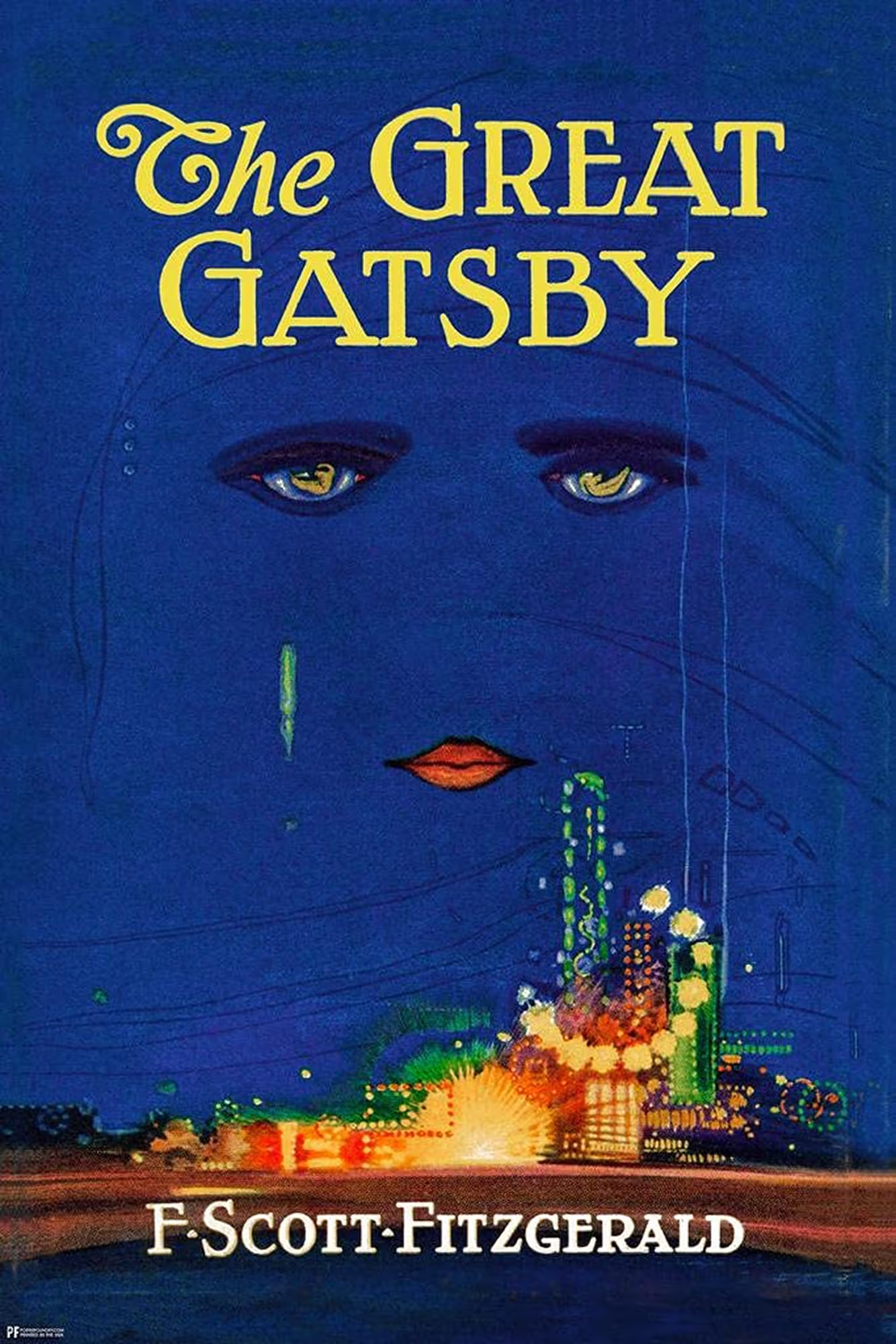
For episode five, Kristy throws Jon a classic, The Great Gatsby by F. Scott Fitzgerald. And as a bonus this season, we'll also be discussing the 2013 film adaptation. We explore the novel’s themes of wealth, ambition, and the American Dream, talk through its major symbols, and compare how the story translates from page to screen.

Kristy (00:00)
Welcome to Books I Make My Husband Read, a self-described hilarious and heartfelt podcast where I, Kristy, the devoted book lover, curate an unexpected reading list for my husband, Jon.
Jon (00:11)
And that's me. In each episode, we dive into lively discussions, humorous debates, and unexpected insights on all the books Kristy just has to make me read.
Kristy (00:21)
We're here to explore everything from your book club favorites to quirky hidden gems, challenging our perspectives and inviting you to join in on the fun.
Jon (00:30)
So settle in, grab your favorite beverage, and get ready for another literary adventure.
Kristy (00:44)
That's gonna make it in.
Kristy (00:45)
Hello listeners and welcome to season four, episode five of Books I Make My Husband Read. I'm your host Kristy.
Jon (00:51)
And hey folks, I'm Jon. I'm the husband. I'm the one that Kristy forces all these books upon me against my will. And then I wind up enjoying most of them.
Kristy (01:02)
It's totally not against your will, but okay. I mean, you do edit the podcast yourself.
Jon (01:04)
Yeah.
I know, I guess that's true. I did sign up for this a little bit.
Kristy (01:13)
Well, here we are talking about our fifth book and film combo this season.
Jon (01:18)
Right. And if this is your first episode listening to us this season, you may not know that we are discussing the book and the books film adaptation. which has been kind of fun. and this week we're going to be discussing all things from The Great Gatsby. That's right, folks, a classic and Nope. That's it. Just a classic.
Kristy (01:44)
yes, and since we've had people ask, we watched the most recent film that came out in 2013 with Leonardo DiCaprio, Tobey Maguire, and Carey Mulligan.
Jon (01:53)
Yeah, there's been a handful. How many have learned? Four? How many of these? Yeah, four there are,
Kristy (01:57)
Yes, and I'm sure 2013.
So in 2030s sometime there'll be another one. So we'll get to enjoy another one. Yes, I put money on it.
Jon (02:07)
Yeah.
Kristy (02:10)
I pick this book for Jon? Well, when I knew we were doing film adaptations, I knew I wanted to do a classic because there are actually a lot to choose from as far as classic books go that have been adapted to film and multiple times usually.
This is one that I knew Jon hadn't read. This was one that I actually hadn't seen the film and was excited to see the film myself. So I just thought it would be a great addition. And I had read the great Gatsby previously. And I do remember a friend telling me that she reads it like every few years and find something to enjoy about it every time she rereads it. So I thought, great, maybe I'll find something new to enjoy during this reread and then watch.
Jon (02:57)
Nice. That's fun. Yeah. I hadn't, yeah, you're right. I hadn't read the book. I actually hadn't seen the movie either. Even though I had, I remember we had wanting to, I kind of loved the whole roaring twenties vibe jazz scene. So I was, I was excited that this one was on the list. So before we get into our full conversation, though, we wanted to let all of our listeners know which books Kristy's forcing upon me next. And those who, those next two books in our lineup are going to be Where the Crawdads Sing
Kristy (02:57)
That's it. Yeah.
Stop saying that.
Jon (03:26)
by Delia Owens. And then our final book, which I know you're very excited about our final book for the season is Project Hail Mary by Andy Weir. And the movie comes out this week in theaters or soon or is it out right now? Yeah, so like end of March or something. Yeah, so.
Kristy (03:40)
I think it's maybe the 20th, maybe it's next week. Yeah, so maybe
by the time this episode airs, be that Friday, I think. But yes, you're not wrong. I'm so freaking excited
Jon (03:49)
episode airs. Yeah, right on.
Kristy (03:56)
this was one of the books that made me think, Hey, let's do film adaptations. Cause I knew he wanted to do the housemaid. I knew he wanted to do a Project Hail Mary, which both had releases this quarter. So that
kind of started it and I'm just really excited. I hope the film is amazing. The trailer looks great. Although I've been kind of trying to avoid most of it because I don't want to know too much. want to go in cold. So I am really excited. I'm going to do that one on audio because I've heard the audio is, is amazing with the extra terrestrial. So I'm excited for that. Yeah.
Jon (04:16)
Yeah, avoid them.
⁓ fun. Okay,
right on. I was gonna maybe, I thought about reading that one, the physical version of that, but maybe I'll do the audio version also. Cool. Ooh.
Kristy (04:40)
And I just saw
a clip of this. So the person who does the audio, the narrator and the audio said he had not read it prior to doing the audio. So he says when he would hear maybe like emotion in his voice while he's speaking, it's because he's experiencing it for the first time too. Yeah.
Jon (04:55)
Dang.
that's a fun little fact of
the okay. Cool. Good tip. and Hey, if you guys wind up listening to this whole episode and you enjoy the show, please rate and review us on Apple podcasts or Spotify or wherever you might be listening to, to us. So.
Kristy (05:24)
Are you ready
for that spoiler free book summary?
Jon (05:27)
I guess that is the time of the season. ⁓
Kristy (05:30)
Nick Carraway, a young man who moves to Long Island in the summer of 1922, finds himself drawn into the glittering, excessive world of his wealthy neighbors. Living next door to the mysterious and fabulously rich Jay Gatsby, Nick becomes fascinated by the lavish parties Gatsby throws every weekend, events attended by crowds of strangers who know little about the man hosting them.
Jon (05:54)
And as Nick becomes part of his social circle, he reconnects with his cousin Daisy Buchanan and her husband Tom, whose marriage hides tensions beneath its polished surface. Through his growing friendship with Gatsby, Nick begins to learn about Gatsby's past, his ambitions and the powerful dream that seems to drive everything he does.
Kristy (06:17)
Set against the backdrop of the Jazz Age, the novel explores wealth, class, love, and the illusion of the American dream. Beneath the glamour and extravagance of the era, the great Gatsby reveals a world where appearance often hide deeper truths and where the pursuit of dreams can come with profound consequences.
Jon (06:36)
Yep, yes they can.
Well, ladies and gents, this...
Kristy (06:43)
⁓ Ladies
and sons of ladies.
Jon (06:48)
we'll go with that. Ladies and sons of ladies, this is the time of the episode where we let you know that everything from this point forward is going to contain spoilers, both the book and the film.
So go shake yourself or stir yourself a martini, pour yourself champagne, whatever your flavor is, jump in the pool and swim on out of here.
Kristy (07:15)
All right, old sport, tell me what you thought about this book.
Jon (07:24)
I have discovered that I don't know if I like enjoy classic books.
here and I don't know that I have a good reason, but I'm just going to share my thoughts. It was, I found it really challenging to get into. I thought the, the setup was like hard for me to follow the, the language and the way the, the style of the prose was different and you could sort of feel its age, so to speak.
and I just found that challenging. found some of the dialogue and dialect to be a little challenging. the storyline in general, a little hard to, ⁓ to parse and, and follow.
And I think I wanted more from it than it than it had or I there would be more mystery. I don't know. My expectations didn't wind up aligning with what the story was. And I don't
I went in totally blind and was just like this one for me was just okay, which is really unfortunate because I want to I want to love it. want to love the era and that sort of like roaring 20s.
just that whole era is just so cool. ⁓ But the fell flat. And maybe it's because of classic and maybe it's because I'm not a literary savant or something, I don't know, but ⁓ it was just okay for me.
Kristy (08:58)
do that again.
I think the things you're bringing up are correct and are why some people don't enjoy it as much as maybe a more contemporary fiction novel. The language is definitely different.
I remember the first time, and this is obviously much older, I read a Jane Austen novel and my friend was, it was Pride and Prejudice. She's like, how are you enjoying it? I was like, I don't think I know what the fuck is going on. It, because the prose is so different, the words that they use are so different. And so she's like, well, what do you think's going on? And then I told her and she's like, yeah, you got it. So it is different, but you pick up, I think what you need to pick up, but it can make reading it physically challenging.
which is probably what you're experiencing. like, okay, I would never say that in the way that F Scott Fitzgerald's saying it, or like the characters are saying it. So I can completely understand that. I also this is one of those novels that
Jon (09:46)
Yeah.
Right.
Kristy (10:02)
F Scott Fitzgerald, Francis Scott Key Fitzgerald, who went by Scott, is trying to get a point across. He's not just writing a novel that is about two characters who do this thing and have this ending, whatever that looks like. He's trying to get a point across about something. So there's a lot of symbolism in the book. There's a lot of like deeper hidden meanings about things. There's things that, you know, make you go, And then
talk about it. And that's why this is required reading or it was in a lot of But I think that, we'll talk through some of these. And so maybe you'll have a different appreciation coming out of this conversation. I'm not expecting to change your mind, but maybe you'll go, ⁓ I didn't think about it that way. Cause I definitely feel like that from books that like I read in school.
And then you discuss them and you start realizing this meant this, and this is what he was trying to say here.
Jon (11:02)
Sure. I fully anticipate that to happen actually as part of this conversation just because I've not looked, I wasn't reading it for symbolism. I wasn't really reading it from an analytical eye like someone would if it was assigned, you know, in the class. So I fully anticipate to learn things in this conversation.
Kristy (11:23)
that in mind, I wanted to tell you when we get into these questions, this might feel a little like an English class. I didn't want that to scare you. So I'm glad you were already set up for that. And you're like not thinking you're going to hate this.
Jon (11:30)
⁓ jeez.
Yeah, didn't. mean, I'm glad you set it up that way because if I didn't enjoy English class growing up, so I probably would have went in with a little bit more reservation. But no, I'm I'm ready to like kind of hear your your more analytical approach to this book. So I assume that's why it is lasted as long as this has. And it is a classic is because of all the symbolism. And I just went right over my head.
Kristy (12:03)
I think specifically the idea of the American dream, one, what that is or what that means. Can it mean different things? And is it achievable? And then that, you know, this was in the 1920s Are we experiencing some of those same things now?
And I think there's a lot of things that are relevant to right now and what that looks like. So exactly what you're saying, like the longevity of the story and how it can be relevant today. But I think really the best way to talk about this book is by going through each of the four main characters and kind of analyzing them within the story, because I think that'll set up some of those thoughts and...
how we have conversation as we like move throughout. But I think we can't do that unless we talk about the characters.
Jon (12:52)
Sure.
Kristy (12:53)
So our narrator is Nick Carraway and he describes himself as someone who reserves all judgment. But do you think he actually does? And how reliable of a narrator do you think he is?
Jon (13:07)
I, I think for the most part, he does a decent job of reserving judgment, though I wouldn't say he's, a hundred percent free and clear of such things, which as human beings is really difficult to do in general. ⁓ but I think he, he does honestly try his best to look
Kristy (13:21)
Absolutely.
Jon (13:28)
the people that he's surrounded himself with through a different lens. He's, he might be frustrated at something, but he's not necessarily passing judgment on, on someone's character or whatever. Well, maybe later on he does actually, but that's probably part of the journey of, his character arc. I think, is he a reliable narrator?
Given my limited knowledge of that term, I think yes. So that's my answer. If I get a B, I'm okay with that.
Kristy (14:07)
this will not be graded unless you want it to be.
Jon (14:08)
Okay, okay, I sure don't
So lay it on me.
Kristy (14:16)
So I think some of the things you're pointing out are, you know, correct or you're like thinking about things in the right way and pointing out the right things. think Nick wants to believe he's neutral. he's a narrator who has strong feelings, especially about Gatsby. And I think that bias shapes how we as readers experience the story. So I think he,
You also remember like, he's a very involved narrator. So he's not telling us this as the story is unfolding and he's kind of watching from the outside. He's a participant in these events and he's telling it to us after they've happened. So it's filtered through memories and reflections and maybe things he wishes he would have done differently or how he thinks something would have gone.
I do think he positions himself as someone that the reader can trust. But I think the way he judges Tom versus how he judges Gatsby or even Daisy, like he's really forgiving of Gatsby's flaws, but he's much harsher to some of those other characters, including Jordan as well, who is more of a side character here, but.
Jon (15:21)
Daisy, yeah.
Mm-hmm.
Kristy (15:34)
But with that said, like, I don't think he's completely unreliable. Like, I don't think he's flat out lying to us about the story. I think it probably went mostly that way. Like, if we had points of views from the other three main characters, they'd probably be pretty similar. I don't think, yeah, so I don't think he's like lied or embellished or anything like that, but I do think we're intended to think of Tom and even Daisy as...
Jon (15:50)
Sure, okay, yeah, that makes sense.
Kristy (16:00)
Like the villains of the story. then Gatsby is the victim based on how Nick is telling it.
Jon (16:07)
because of how he views Gatsby and because of his...
desire to be like Gatsby?
Kristy (16:11)
Well, no,
I just think that if he was a truly impartial narrator, the story would feel colder, maybe, because you feel the love for Gatsby and the admiration for Gatsby and then the hurt when the fallout of Gatsby dying and, spoiler, and no one coming to his funeral and no one caring.
Jon (16:23)
Hmm.
Kristy (16:38)
No one caring at all and how much that like angered and hurt him. And if he was just, if he was presenting Gatsby in the same way he presents Tom, who have a lot of the same flaws, then I think the story would read differently. So I think he's intending to be like, this is how it happened, but still through the lens of his emotional tie and admiration for Gatsby.
Jon (16:38)
Yeah.
Kristy (17:05)
and the disappointment he has in everyone else around him in the story.
Jon (17:09)
I see, I see. Okay, there, I learned something.
Kristy (17:13)
Yay!
Jon (17:14)
You
Kristy (17:17)
Alright, so what did you think of next on the list? What did you think of Gatsby as a character? Is he romantic and admirable or is he ultimately delusional?
Jon (17:27)
I know you usually hate when they answer questions like this, but I would say he's probably like somewhere in the middle of that spectrum in does he have certain romantic and admirable actions ⁓ based on his, his love and admiration for Daisy? Yes. Do we think some of them are also a bit misplaced? Yes.
Do I think he's a bit delusional in his grand vision of how easy it'll be and that he'll just woo her so quickly pick her up like Prince Charming and off they go into the castle and live happily ever after? Yeah, I think he's probably a little delusional with that.
I think there are droplets of all of those traits within him, which probably makes what makes him a really interesting character to for or or look at as potentially the you know, a victim of the story or the protagonist of the story, I guess, if you want to call it that. what do you think? What's your response?
Kristy (18:36)
I think you're right. think he's He's romantic and his devotion and ambition, but he's also, like you said, he's deeply delusional about the past and about who Daisy really is.
Jon (18:39)
A plus.
Hmm.
Kristy (18:54)
Gatsby is the ultimate dreamer. Everything about him is built on a single idea, which is recreating the past with Daisy. His wealth, his mansion, the parties that all exist to bring Daisy back into his life.
Jon (18:57)
You're right.
Kristy (19:12)
And there is something admirable about that level of devotion. I mean, the man completely reinvents himself. He comes from nothing, builds a new identity, visions a better life, all for Daisy.
Jon (19:16)
You
Kristy (19:28)
The problem with that is Gatsby just, he doesn't just want Daisy back. If he just wanted Daisy back, this would be a different story. But what Gatsby wants is to erase the last five years of both of their lives and pretend that didn't happen at all.
Jon (19:48)
Right.
Right. Good. True. Good point. And that's that's very pointed in the book and the film.
Kristy (19:54)
Yes. Yeah. So
when Nick makes the comment, you can't change the past and Gatsby says, sure you can. He's like so flipping about it. Like, sure you can old sport. I think that's when we get the first real glimpse at how detached from reality he really is.
Jon (20:14)
Gotcha. Yeah. Okay.
Kristy (20:15)
So Gatsby
isn't in love with Daisy as she exists now. He's in love with this idealized version of her and really what she represents, I think, wealth, status, the life he believes he was meant to have.
Jon (20:28)
Yeah.
Yeah, which I think in real life, a lot of us do a lot of us fall in love with the idea of someone or the idea of something and choose to misplace or displace some of the realities that come along with with those ideas and those ⁓ desires.
Kristy (20:40)
Mm-hmm.
Yep. So what I think that Fitzgerald does here is he creates a character whose qualities, the hope, the devotion that Gatsby has almost seem heroic, but they're also deeply tragic because they're not at all, like I said, grounded in reality.
Daisy is one of the most debated characters in literature. Did you find her sympathetic, frustrating, or somewhere in between?
Jon (21:23)
This one is actually probably a little bit harder for me to answer with any clarity because I struggled with her in the book of just like understanding her motivations, understanding her point of view, understanding where she was coming from. ⁓ I was just, I think I was missing a lot of the depth.
of her character from the book.
so I struggled with her just like getting a good grip on her, on her as a, as a character. I struggled with it through the pros. I struggled with it. Just her devotion, like between Tom or to Tom, her relationship with Nick even felt a little like.
I know they were cousins, but like somebody could have come across as flirtatious or whatever as well. so
Kristy (22:15)
I think it's also a little style
of the language back then that, but yeah, but you're not wrong. Yeah.
Jon (22:19)
Yeah, I agreed, agreed.
So, guess I can understand why she's probably one of the most debated characters, because I'm sure she's wildly complex, I, her complexity, I think just went over my head.
Kristy (22:34)
I don't know that it went over your head, but I think that maybe exactly what you said, you know, she is one of the most debated characters for that reason, because some people pick up on, you know, some things, some people pick up on other things. think, like the question, she's both sympathetic and she's deeply frustrating.
I find her sympathetic because I think the expectations of women during that time were very narrow. I think they're especially narrow in the rigid social world that she grew up mean, think about the line where she says she wants her daughter. that she hopes that she'll be a beautiful little fool. Like
It sounds to me like she's understanding the limits placed on women within her society, like at that time. Not just in society, but specifically like I said, in her social circle.
Jon (23:24)
Yeah, that line. I actually I thought she was referring to her relationship with Tom because that unfolded right as like Tom's mistress was calling the house and she was frustrated. She knew who it was. And so I thought that line when she was telling Nick that about her daughter that it was more about which I guess maybe that's what you're saying. But
Kristy (23:41)
That's exactly like, it's all those things.
So it's like, I'm only this, I'm only a housewife. I'm expected for my husband to cheat on me. I'm expected to look a certain way and keep a certain household. Like do all those things that were expected of, you know, wealthy women during that time period. yeah, yep. So for all those reasons, like I had sympathy toward her because she lives in this...
Jon (23:58)
I see.
Kristy (24:07)
very rigid, like narrow lane of life. And she had few opportunities to experience a different way of living. But of course she's also deeply frustrating because she refuses to take responsibility for the consequences of any of her choices. she's also extremely careless.
and she moves through life protected by the status that the wealth gives her. But I think for Daisy, and maybe this is like,
you kind of pointed out maybe not in this language of what I just said, but like you pointed out both those things.
But I think Daisy's biggest flaw for me is avoidance. So if you think about the story, when situations become uncomfortable or morally complicated, Daisy tends to retreat. She doesn't want to confront them at all.
Jon (25:01)
Sure.
Kristy (25:02)
So Gatsby has tracked her down years later, he's amassed this wealth for her and yet she just wants the affair to be enough. And so I think that's why readers find her frustrating. And then we try to confront her on these things. She just avoids it and she lets the affair continue. She kind of, she strings him along in a way because like he wants to tell Tom and yet she's like, can't this be enough? And then when she wants to confront, he wants to confront Tom at the dinner.
she avoids and like, let's go to New York.
So yes, she's sympathetic. Yes, she's frustrating, but she's also just a product of her environment.
So I think what Fitzgerald does with this character is he uses her as a symbol of wealth and status and the hollowness that comes with it.
Jon (25:53)
Interesting. Okay. Okay. That makes sense to me. It makes sense to me.
Kristy (26:00)
Okay, so our fourth character, Tom, he's clearly problematic, but do you feel like the novel uses him simply as a villain or does he represent something larger about wealth and entitlement? Different than Daisy does.
Jon (26:14)
I took him as the villain of the story.
right, wrong or indifferent. did sort of I did pick up on, you know, that Gatsby shared some of his characteristics or traits.
I think you're as the reader meant to root for Daisy and Gatsby to be together. And he plays the the linchpin that won't allow that to happen. You know, that's not really true. But that's, I think that's how I
That's how I read it. And that's how I took it. And because he was sort of unmovable and he wasn't going to
give Daisy what she wanted, I guess, for lack of a better phrase that he was sort of the villain.
But I think to your point, is sort of, I think he does represent thinking about a little bit more through this conversation. He does represent a say something larger about sort of entitlement and wealth and what that means. So, yeah.
Kristy (27:12)
Yeah, Tom is an interesting character when you think, like you said, the wealth compared to his money and then like Gatsby. So Tom is arrogant, he's openly racist, he's controlling, he's hypocritical, horribly hypocritical. And I Fitzgerald wants us to feel repelled by him.
at like every page that he wants us to go, that's horrible. know, he's this horrible person because Tom isn't just a person. What he's representing in the book old money. Unlike Gatsby, who's built his wealth, who's built his own identity, Tom was born into privilege and he's never had to earn anything in society.
That's why he feels threatened by Gatsby.
Jon (28:00)
All
right. Okay. Yep. I see that. I picked up on that.
Kristy (28:05)
Yeah.
Yeah. So Gatsby's success challenges this idea that wealth and status only belong to people like Tom. So Tom sees Gatsby as this outsider trying to infiltrate his world.
Jon (28:20)
Hmm. Interesting. Okay. As opposed to an equal because they're, they're both equally wealthy. It's how that wealth was accumulated separates their status. Interesting.
Kristy (28:26)
Mm.
Exactly. that's what,
right. So
So you already pointed this out or we discussed this, but Tom's entitlement also allows him to act without consequence. So he cheats on Daisy, he treats other people poorly, he creates chaos, but in the end his wealth completely insulates him. about the circumstances that they left Chicago.
He literally created chaos there with his affair. And then they just moved to New York City, like nothing happened, just living it up.
Jon (29:01)
And that's what Daisy was referring to when she referenced that in the book. And now he's doing it again in New York, worried that they're gonna have to just pick up and move again somewhere else,
Kristy (29:10)
Exactly.
Right.
And that really ties into the novels bigger themes. So I feel like Fitzgerald is critiquing a system where the wealthy can cause damage, then retreat into their palaces and others have to pay the price. So Tom, I mean, he is really the villain in the story, but he's not just a villain. He embodies this carelessness and destructive power that
inherited wealth can bring.
Jon (29:43)
I mean, he's really a byproduct of his environment, no different than Daisy is a byproduct of her environment as well, right? Like you kind of, those, those two feel very similar. I mean, obviously there's gender differences, but they're still both byproducts of their environments. Yeah.
Kristy (29:53)
Yeah.
Vast, yeah.
Yes, but I think those are large and the way and how destructive like Tom is and yeah. And also how he treats people as well.
The novel is often described as a critique of the American dream. What do you think Fitzgerald is saying about ambition, success, and social mobility?
Jon (30:20)
Well, a couple of things, I guess I would say that it's one of the things that I took away from the book is that
it's lonely at the And it's kind of, I took that from Gatsby's death and how no one, no one came for him. No one came to his funeral, even though they all freely partied at his house and spoke of him highly or, whatever. I think that
There is a ruthlessness to social mobility and success, which honestly probably isn't all that different from today. And there's a cost to, guess, there's a cost to the American dream and what version of the American dream are you wanting and how much are you willing to pay for it? So.
In my limited literature ⁓ lens, those are my takeaways from in those themes.
Kristy (31:23)
I think what you're pointing out is right, but I think there's like a larger point. So, ⁓ like, and I don't think that's bad. I think like you're right there. So I think in the world that Fitzgerald creates in this novel, so we'll like, obviously you're seeing things.
Jon (31:31)
⁓ I would absolutely bet that there is.
Kristy (31:47)
historically like this, we're seeing things now like this, but in this novel specifically and what Fitzgerald creates for us, I feel like he's suggesting that the American dream is distorted. So Gatsby really represents the classic version. And again, how we obtain his wealth aside, but he comes from
He comes from nothing. He reinvents himself through this ambition and determination misguided as it is, but on paper, achieves what the dream promises. Wealth, influence, this new identity. But what he does not get is acceptance. So despite the wealth, it's the old money that really never accepts him.
into their world. So the Tom's in the daisies of the world. So I think what Fitzgerald is saying is social mobility has limits. And that suggests matter how someone works, there are barriers that are going to keep certain people on the outside,
And then I think, and you actually were like, what is the American dream kind of thing? think that the book distorts that or shifts that a little bit. And it's like, is it from building a good life just chasing wealth and status? know, like which one is it? Like, do we think of the American dream is like, I have what I need. I'm free versus like, I have to have everything.
and be accepted in this way that I might not get.
Jon (33:21)
Yeah. Gatsby even at one point talks about like, there's no stopping. has to keep climbing or he has to keep going up. which probably speaks to that. Where do you think Nick falls? Like, do you think
Kristy (33:30)
Yeah.
Jon (33:35)
is Nick's character just a different flavor of the American dream compared to like Gatsby's and Daisy's and Toms?
Kristy (33:44)
I think that's a great question. mean, I would think that Nick represents that other, like, I have enough, I have a job, I don't need to be excessive. I mean, he leaves the Midwest, he moves to New York, he is drawn in by the glitz and glamour of it and like the vastness of it. And he seems very content with living in his little cottage and
Jon (33:55)
Yeah.
Kristy (34:12)
at his bond's job. I think he's happy with that.
Jon (34:15)
Yeah, I thought so too. That's how I took it. That's what made me think of the question if he was sort of meant to portray like that version or that side of the spectrum ⁓ of the dream.
Kristy (34:28)
Yeah. So my last point here with this is I think what Fitzgerald is trying to ask the reader is, is the dream real? Or was it ever real?
Jon (34:40)
Got it.
Kristy (34:42)
Like the idea that this promise of just like limitless opportunity is really partly an illusion when things like social class and privilege and old money wealth still control access to things.
Jon (34:57)
Yeah. Do you think it's an illusion?
Kristy (35:00)
in the era we live in now, yeah. Yeah. Yeah. I think there's a little room for people with the way the wealth gap is widening.
Jon (35:02)
Yeah, I mean, it's the only one we know.
Kristy (35:13)
there is such a narrow lane for people to be successful entrepreneurs and there's people that are going to argue with me on this, like have this like million dollar idea kind of thing. Like that used to be like the million dollar idea. Well, if it's not a billion dollar idea anymore, it doesn't even matter.
So I think what I think of what the American dream was actually the podcast, I think I mentioned this podcast last time that Obama and Bruce Springsteen did, they actually talked about the American dream and what that means. And Bruce Springsteen and his family like felt like they were living the American dream growing up. Like his family was poor, but he's like, we always had enough food on the table. We always like got something for Christmas. We were clothed, we were happy.
And that to us was living the American dream. We were free, we were fed, we were happy. And now it's like, people think of the American dream as this enormous amount of like, obtaining this enormous amount of wealth. And if that's what the American dream is for you, I think that it's very narrow. And I don't think a lot of people are ever going to achieve it again with the idea that it's still there's limitations.
Jon (35:59)
Yeah. Right.
Kristy (36:26)
that old money has on access versus living just a life where you can provide for yourself.
Okay, last question before we move into talking about the film adaptation. Why do you think The Great Gatsby continues to resonate with readers nearly a century after it was published? Or maybe you don't because it didn't resonate with you. ⁓
Jon (36:46)
maybe, ⁓
but I mean, through this, through this discussion, think I formed an answer to this question now in that it, it still speaks to, societal like.
entitlement or status of wealth. It still resonates.
in, I mean, for me personally, because I just think the the 20s are just such a fascinating era to begin with, in all kinds of ways, both like economically in the country, musically in the country, ⁓ technologically in the country, of course, there's also, you know, the great crash and all that. But I just think the whole decade is just, yeah, I just think that what?
Kristy (37:18)
Mm-hmm.
Prohibition. Women could vote.
I know, right? Did you know that? 51 % of the population actually gets a say.
Jon (37:39)
no.
⁓ So I think it speaks of themes that are deeply rooted in humans, no matter if it's a century ago or not. So that's my takeaway from our conversation on this book so far.
Kristy (37:57)
Mmm.
Yeah.
I think those are great takeaways. Yeah.
Jon (38:09)
Thanks.
What about you? Why do you think it still resonates?
Kristy (38:14)
I think the idea of chasing status or success or wealth, whatever that looks like for an individual is something that most people in some way can relate to. Like the idea or I wouldn't even say the idea, the pressure to achieve wealth or the perfect life, the idealized life, like that hasn't changed. know, we're a hundred years later, that really hasn't changed.
And I think the novel also explores the gap between appearance and reality. And that feels especially modern. Many characters project this glamorous image while hiding messy or unhappy lives underneath. I mean, if that doesn't play out on social media, like I don't know what it is. And F Scott Fitzgerald had no fucking clue what social media would be.
Jon (38:58)
every day. Right.
But yeah, is that very just human, very human behavior. ⁓ Any, any way you slice it.
Kristy (39:11)
Yeah.
And I think Gatsby specifically is a timeless character. I think people connect with the idea of believing so strongly in something, in a dream, in whatever it is, even when it's unrealistic. People admire that.
Jon (39:32)
Yeah.
Kristy (39:33)
Like you put everything into this one thing, your whole determination. Like that is something that people admire, connect with, whatever the case may be. Like we love stories like that. We love stories like that.
Jon (39:41)
and the, yeah.
Kristy (39:46)
And then we've already touched on this several times, but the book also critiques privilege and equality and shows how wealth can protect some people while other people have to face the consequences.
Jon (40:00)
Preach.
Kristy (40:01)
Yep.
The poor's poor. Yes. The non one percenters, which is all of us.
Jon (40:04)
The pooors. Oy.
99 % Yeah, yeah, it came off. That's funny. came off funny.
Kristy (40:14)
Sorry. I was actually thinking like the wealth, not the percentage, but yeah, you're right. Yes.
Math is hard. Not that hard. All right. Let's transition the film and talk about that a little bit. one of our biggest criticisms in
Jon (40:32)
Okay, finally.
Kristy (40:38)
The film adaptations that we've covered this season is how directors have chosen to bring internal dialogue and first person narration to life on screen. In this film, they added a framing device with Nick writing the story in a sanitarium. What did you think about this?
Jon (40:57)
I okay, two things one in like full transparency mode. When we started watching a movie, I was like, is this what the did this happen in the book because I didn't pick it up if it did, which wouldn't surprise me because I also, I had said like, the whole first chapter two in the book were just so hard for me to ground myself in what was being what's going on. So I was like, is
Kristy (41:07)
Yeah.
What's going on? Yeah.
Jon (41:22)
this how because this is kind of cool. But anyway, I thought it works really pretty well actually to communicate the story and to communicate it. So verbatim, which I have other thoughts on from the book is even down to like the dialogue, how the dialogue was delivered and things like that. And so it made sense because in the film, he's writing the book.
⁓ So I thought it was I thought it was a great mechanism. Once I realized it was an actual mechanism and not like how the book was.
Kristy (41:52)
Yeah, I absolutely agree. Yeah. Yes, this does not happen in
the book. It is a mechanism and it is leaps and bounds the best way used. Although obviously Shawshank is amazing, but
My only critique of it was that I feel like there could have been more use of that and less seen that way readers could have got like some of, because the story is told through Nick's lens.
Jon (42:24)
Right.
Kristy (42:24)
And
you don't connect with it in the way you're supposed to in pull on film. It's just a story. But right, you're seeing a story in the book. You're learning about the ideas and the message that Fitzgerald is trying to get across. I don't think that comes through in the film. And I actually think I have a question about that, but the tool used a plus to the directors.
Jon (42:31)
I see what you're saying. Okay, yeah.
Right. I agree.
Yep.
Kristy (42:52)
I love
the idea that he's writing this book. Love that he like changed the name at the end. I thought that was cute. Like, yeah, yep.
Jon (42:58)
Yeah, that was great. Little touch, yep.
Kristy (43:01)
Were there moments from the book you felt were missing or changed in a way that affected the story?
Jon (43:07)
I didn't think of any, but I think you just alluded to it in your answer previously about how you're not getting the symbolism or the message that's being delivered through these characters because you're just getting from the story. I wouldn't have thought about that on my own, so I'm totally stealing your answer for this one. ⁓ Thanks, real good job. ⁓ How would you, would you steal your own answer for this, or do you have a different answer for this question?
Kristy (43:26)
Yeah. Good job.
Well, I have a couple, I have a couple of things. think that, I think, like we've talked about the mechanism. I don't think we get enough of it because we, think we need more of Nick's internal reflection to really understand the moral emptiness of the world that he's observing and writing about that just doesn't come through.
Also, there's very little of Jordan Baker and the role she plays in the movie. She's there, but like you don't learn anything about her. And in the movie, sorry, in the book, she adds to that moral emptiness. When you think about her cheating in the golf game or implied that like she cheats at the golf game. And then there's like another scenario where Nick actually realizes like, ⁓ she actually just doesn't fucking care.
Jon (44:03)
Yeah.
Kristy (44:22)
And it's because she's the same circle and she can do these things without consequence. So we don't get her really a lot on the screen. And I think that she represents that in the book. I also think it's interesting how they portray how Gatsby made his money in the film versus in the book. In the book, it's implied that he's like a bootlegger.
Jon (44:23)
Yeah.
Got it.
Kristy (44:51)
But it's clearly over in the movie. Like there's no doubt that how he's made his money. But I feel like the book is intended to give you like almost the mystique of Gatsby. Like, is he in some illegal stuff? No, he can't be in some illegal stuff. He sees like such a stand up guy. He calls everyone old sport. This guy can't be doing illegal shit. Like he seems like such a good dude. It kind of makes you question.
Jon (44:54)
Yeah.
Yeah.
Kristy (45:20)
And then it also makes you, when you feel the fallout of no one caring about him, it also makes you not care about how he made his money. I mean, I didn't agree with prohibition, so I don't really know that I would care. mean, Tom seems to really care about how Gatsby made his money, yet he's visiting speakeasies, so, right.
Jon (45:28)
Yeah. ⁓
Right. And enjoying the, yeah, the
privilege of that. Yeah. I actually, ⁓ there was a moment in the book where I actually wondered if, ⁓ Gatsby's money was just all a fallacy. Like he actually didn't earn anything. He had no money at all. It was all just show, ⁓ pomp and circumstance, you know, dog and pony show, whatever other metaphor you want to use, smoke and mirrors.
Kristy (45:55)
no money. Yeah.
Smokin' Mirrors.
Jon (46:08)
Obviously, that wasn't the case, but that did cross my mind a couple of times. I think maybe it's because of how it was written. was sort of like there was a mystery to it. It wasn't very explicit. It wasn't clear how or where it came from.
Kristy (46:18)
Yeah.
Yeah, exactly. Like I think that's a great point and in shows that you felt that way as well.
Jon (46:27)
Yeah. Yep.
Kristy (46:29)
Second to last question, because you always know what the last one really is. If someone has never read the book, do you think the film would communicate the story clearly?
Jon (46:40)
No, I think you can watch the movie be entertained and but good one. But I don't as with so many adaptations, like I it just falls flat with some of the depth of what the book is trying to communicate. Even though, like I said, I didn't really get the depth when I read the book either until we talk about it here. But I could see that.
Kristy (46:46)
Are you not entertained?
You're like, the
book's under 200 pages. How do you have so much to say?
Jon (47:13)
Yeah, I think the book can stand on its own. Or I'm sorry, I think the film can stand on its own.
One thing that I wish the movie would have done, there's a nuance in adaptations when...
something is based on a book and when something is inspired by a book or a story. And I feel like when something is based on it, it's much more literal, it's much more direct to the book. And when something's inspired by the director and the creative team can have a little bit more creative liberties with this. I wish this would have been more inspired by the book and not based on the book. like, especially if you're going to take stylistic
liberties with some of the things like the music and the flashiness and maybe something like things like push that further, use regular dialogue or, you know, just move away from having to feel like you have to hit these specific moments from the book. So anyway, that's I'll get off my soapbox about that now and you can answer your question.
Kristy (48:07)
Yeah.
To
that point, this book would be a wonderful film that is not set in the 1920s, but is set right now. And literally you can tell the same story with wealth, with someone trying to enter that realm with...
Jon (48:31)
Hmm.
Kristy (48:41)
I don't know. Someone said, I'm just going to say someone like making their money selling drugs, however people make money illegally now, who knows, washing money, racketeering. throwing out words. But I think that would be, I think that would be a wonderful film. It would tell the story and it could still get the message across that Fitzgerald I think is intending to say, but it doesn't have to be set then.
Jon (48:57)
Yeah.
I wonder if, and I think this is the same director, Romeo and Juliet movie with Leonardo DiCaprio and ⁓ Claire Danes from way back in the 90s, like that very stylistic approach, even though they use Shakespearean language in there, but it was set in modern day. And so I think hearing you say that, I'm like, yeah, this could totally fit that similar sort of style also.
of a sort of modern take on that. So that would be pretty fun. I would go see that. Maybe that'll be the fifth iteration of this book. Yeah. Here's our $10,000 idea.
Kristy (49:35)
It is the same director. Yep.
Yeah, who do we pitch this to?
Yeah, $10,000 deal. We'd probably have to pay someone to do it. We would make no money. We would be poor.
Jon (49:55)
Anyway...
Kristy (50:02)
So yeah, think the movie's fine. It's not a great, it's a fine, it's just okay. It's fine, whatever. Yes, I would lean more to six, but.
Jon (50:05)
Yeah.
Yeah, six or seven for me.
I
probably would too.
Kristy (50:15)
But the book is, it's really trying to get a message across and the film just does not do that. The film is about other things. The film is about the tragedy of the relationship in Gatsby, not the...
What does, yeah, the societal, like, what does the American dream mean? Is it achievable? This moral decay, like, that's what it's about.
Jon (50:33)
excited.
truth. I actually learned a little bit so you know I won't transfer next semester out of this one.
Kristy (50:45)
So how did you enjoy English class today?
So with that, now here's my actual last question that I always ask. Maybe after our discussion, do you have any final thoughts on the book? Anything maybe that like popped up? Would you recommend this to our listeners and should they watch the film?
Jon (51:12)
Yeah, I think I have a new, better appreciation for the book after this conversation. think it's, I understand a little bit better why it's a classic. ⁓ honestly, after reading it, I wasn't really sure, like, what am I missing? Like, why is this book so fucking popular? ⁓ Or has lasted so long, shouldn't say popular, but it's lasted as long as it has.
movie. You know what? It's, it's fun. I think it can stand on its own. It's an entertaining to it's a decently entertaining two hours. It's not super It's, it's flashy and the style is cool.
I think Toby McGuire is actually, thought like a weird casting choice personally for, for Nick. I don't know why, but I just, he just felt like the odd man out. ⁓ I realize he is a little bit in the book too, but it went to like another level with, with his cast. Not that I, I don't dislike Toby McGuire. I I just think he was not the right person cast for this. Anyway. ⁓ those are my final thoughts.
Kristy (51:57)
I did too! ⁓
Yeah.
I
also think that there's an audio version of this book that Tim Robbins narrates. And so that's Nick Carraway to me because he's just this awkward dude. And don't know, it didn't translate on screen with Tom McGuire, who I have no problems with, except I feel bad that his name is Toby, but I don't really have.
Jon (52:23)
And we love Tim Robbins.
Kristy (52:42)
problems with him as an actor in general, but I don't feel like he met the moment of what I feel when I read about Nick Carraway.
Jon (52:52)
Yeah.
Yep.
Kristy (52:54)
All right, old sport, if you got nothing else, we want to remind everyone that the next, we want to remind everyone that the next two books in our lineup are Where the Crawdads Sing by Delia Owens and Project Hail Mary by Andy Weir. And as always, don't forget that a free way to support our show is by leaving us review and rating us on Apple podcasts. If you don't want to rate us, but you have a question or feedback on the show,
You can email us at booksimakemyhusbandread at gmail.com. We'd love to hear from you.
Jon (53:25)
You would and tell another book lover tell your dog play it for your babies. We don't care. It still counts as a stream. ⁓
Kristy (53:32)
I mean, I love that you tell your dog, but unless he
knows how to speak or use a laptop, not helping us out.
Jon (53:39)
Yeah, yes,
not helping us. Anyways, tell others that you think might enjoy the show and maybe there's a book that we've covered in the past couple of seasons or this season that they've read and ⁓ we'd love to hear their thoughts on it. So, that's it.
Kristy (53:54)
Yes.
Well, I guess that's it.
Jon (53:58)
That, my dearest Kristy, is another one in the books.
Kristy (54:02)
Well, who knows? Maybe this will be the one your husband reads. Or maybe he already has because he read it in high school and you can have him read it again and really understand it and then talk about it.
Jon (54:15)
or not, like me.
Kristy (54:18)
have him read it, not understand it, and then listen to this episode and his mind will be blown.
Jon (54:19)
Yeah, blown.
Okay then, love you, bye bye.
Kristy (54:27)
See ya.
podcast, books, audiobook, book reviews, book analysis, book review, book community, book recommendations, book podcast, fiction lovers, must read, novel, adult fiction, fiction, classics, the great gatsby, gatsby, great american novel, literature. Jay gatsby. Daisy Buchanan, nick carraway, classic literature, f. Scott fitzgerald


