

Feb 3, 2026
•
50 min
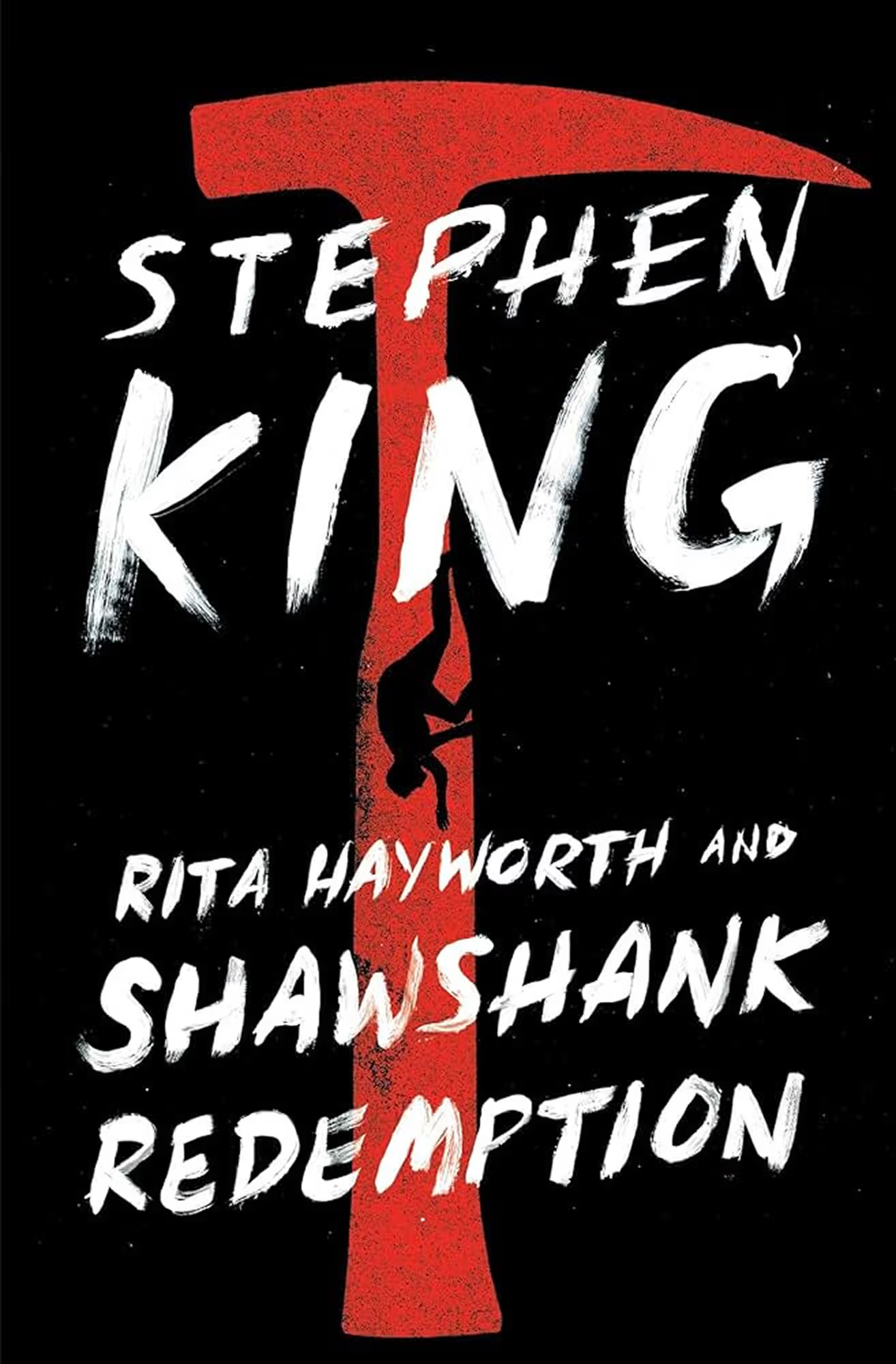
In this episode, we sift through a classic: Stephen King’s Rita Hayworth and Shawshank Redemption—yes that movie. We talk about what makes this story so enduring, the unforgettable characters, and what it means to stay human in a place designed to break you.

Kristy (00:00)
Welcome to Books I Make My Husband Read, a self-described hilarious and heartfelt podcast where I, Kristy, the devoted book lover, curate an unexpected reading list for my husband, Jon.
Jon (00:11)
And that's me. In each episode, we dive into lively discussions, humorous debates, and unexpected insights on all the books Kristy just has to make me read.
Kristy (00:21)
We're here to explore everything from your book club favorites to quirky hidden gems, challenging our perspectives and inviting you to join in on the fun.
Jon (00:30)
So settle in, grab your favorite beverage, and get ready for another literary adventure.
Kristy (00:44)
That's gonna make it in.
Kristy (00:46)
Hello listeners and welcome to season four, episode two of Books I Make My Husband Read. I'm your host Kristy.
Jon (00:52)
And I'm the husband. I'm Jon. I'm the one that Kristy forces to read all of these books.
Kristy (00:57)
Yes, I do. Well, if you missed our first episode of this season, then you may not know that this season actually has a theme. So we will be discussing seven books that have also been adapted to film. We discussed The Housemaid in our first episode. We also discussed the recently released film. And this week we're going to be discussing Rita Hayworth and Shawshank Redemption by Stephen King. Sadly, no relation.
And if you've been living under a rock for the last 30 years, then you may not know, but most of you probably do,
that Shawshank is a story about an unjustly imprisoned man who quietly endures the brutality of prison while building an unlikely path to freedom and hope. And of course, we will be discussing the film as well, which was nominated for seven Oscars. episode I said that it had won a bunch of awards. I was completely wrong by that. It was nominated for a bunch, but 1994 was a great year. That's the same year that Forrest Gump came out. It's the same year that Pulp Fiction was in.
theaters so it did lose to some of those it didn't win any awards and actually
It didn't do very well at the box office at all. It actually kind of flopped at the box office from what they thought it would do. And then it kind of gained this following post box office, I guess, when we had things like renting VHS for our videos. Yeah. And now it is what it is.
Jon (02:05)
Huh.
I would have thought that.
Yeah. Yeah. I mean, I actually had my head that at one best picture. I don't know why I had that in my head, maybe because it is just so good.
Kristy (02:25)
Forrest Gump won, yep, yep. Forrest Gump
won Best Picture and Tom Hanks won Best Actor that year. Over, Morgan Freeman.
Jon (02:36)
crazy,
Kristy (02:38)
Okay, so why did I pick this book for Jon? Well, I said this last episode, but a lot of people actually don't know that this is a book, that Shawshank Redemption is a book. It is a novella by Stephen King. It was actually released with three other novellas, one being The Body, which was what everyone knows as Stand By Me, the film. And so those four novellas were published together in a book.
or however they were bundled together called different seasons. And it was supposed to represent like different seasons of life. And this one Shawshank was spring and it was like representation of hope and like good things to come. So I had seen the film before I actually read the novella myself, read the novella. I think it's great. I think the film adaptation is one of the best and
Jon (03:24)
Interesting.
Kristy (03:36)
we're in and talk about that, but just a classic. Most people have seen the film. Some people have read the book. And I think it's just, obviously it's short. It's about 100 pages you can read in one sitting. And I think there's things about the book that aren't in the film and vice versa. And overall, just like makes it for this really great story.
and I knew you really enjoyed the film and since we were doing film adaptations I thought this would be a great one to throw in and it's short so I knew you wouldn't complain.
Jon (04:07)
That's true. I did really enjoy the length of it. But before we get into the full length conversation, we want to make sure to let everybody know what the next two books slash movies Kristy is going to make me read next, which are People We Meet on Vacation by Emily Henry currently out on Netflix and Regretting You by Colleen Hoover. Hoover.
Kristy (04:10)
Ha ha ha ha!
Yes.
Can you please finish People We Meet on Vacation so I can watch the film?
Jon (04:39)
I'm like halfway through getting there.
Kristy (04:41)
Dying. Dying.
Jon (04:43)
Yeah, yeah. But but but before we get into the next part of the episode, which is the summary, don't forget, you can follow us on Instagram, tick tock and YouTube. And we're actually we've been on YouTube for a while, but we're actually putting video and putting our faces out there for the world now and not just our voices. So go have a look slash listen, we're there.
Kristy (05:03)
Yes, and if you're enjoying this show, please rate and review us on Apple Podcasts, Spotify, or wherever you happen to be listening right now.
Jon (05:10)
Or watching. All right then. So this part of the episode is a spoiler free book summary.
Kristy (05:18)
Andy Dufresne, a quiet banker, is convicted of killing his wife and her lover and sent to Shawshank prison for life, even though he insists he's innocent. brutal and corrupt and Andy quickly learns prison is designed to grind people down.
Jon (05:33)
The story is told from the perspective of Red, a longtime inmate who becomes fascinated by Andy's calm refusal to give up. Over the years, Andy's skills make him useful to guards and officials, and he slowly earns small privileges while building an unlikely friendship with Red.
Kristy (05:50)
As time passes, Andy holds onto hope in a way that feels almost impossible at Shawshank. The novella becomes a story of survival, patience, and quiet rebellion, and what it takes to stay human when everything around you is meant to break you. If that doesn't feel relevant, I don't know what is.
Jon (06:07)
Yeah, no shit. So that was the spoiler free summary. This is the part in the episode where we warn everybody that we are going to get into spoiler territory. So if you don't want any spoilers, this is the time. Listen for the swoosh and hit pause and come back after you've read the book or seen the movie.
Kristy (06:33)
Okay, so we did our spoiler free summary. I'm just gonna give you a quick little now spoiler summary.
so Andy survived Shawshank by staying calm, keeping his head down and quietly building relationships, especially with Red who becomes his closest friend.
Over time, Andy uses his banking skills to help guards and prison officials, eventually creating a financial identity for the corrupt warden so thoroughly that it becomes his leverage. The hope that Andy clings to turns out to be a plan years in the making. He escapes Shawshank through a tunnel he slowly carved from his cell, crawls through sewage to freedom, and disappears with the money he's been hiding under the warden's nose. True to his word, he leaves Red a trail to follow and Red finally choosing hope.
breaks parole and finds Andy waiting for him in the open world.
all right, let's talk about what we thought about this book. So in general, I think I covered a little bit when I said why I picked this book for Jon, I just love the story. I love the story of hope and just holding onto things for the idea that things can be better, that even if you're in...
the absolute worst situation in a situation you absolutely did not deserve to be in, that you have to be able to cling to that hope and that your hope can then have an effect on other people and give them what they need to endure and make it through. And I think that both Tim Robbins Morgan Freeman do such an amazing job of bringing these characters to life. So I love the book. I love the film.
I just think that they're such a great story and then there's I'm just really excited to talk about this.
Jon (08:14)
Yeah, right on. The book, as you alluded to, was nice and short. I actually finished it in like an afternoon, ⁓ which was a nice change of It was interesting for me too that, having seen the movie so many times before and then read the book, that...
it was hard not to picture places the movie, you know, within the book, the characters, especially, or like the dialogue. But to that point, I was surprised by how true to the book the movie actually was in a lot of ways, like even in a lot of the dialogue.
and recounting of it was just like, wow, this really did feel like the movie. Yeah, there are some things that are different, which we'll probably get to in our questions and conversations. But in general, I was just like, wow, this really did feel like the movie. So it was cool. Now I can say I've read it and I've seen it.
Kristy (09:10)
Yeah.
think you're right. There are a lot of things here that are very in the book that are very similar to the film. Specifically, Stephen King has said he actually really loved this adaptation. There books that he sold the rights to that he has actually completely hated. One being The Shining, which is crazy because The Shining with Jack Nicholson is another movie that's like wildly popular kind of in the
public domain of just pop culture and like, what's the word I'm looking for? Like a cult, like a cult falling almost. Yeah. Yeah. Cultural phenomenon.
Jon (09:47)
Yeah, I was going to say pop culture, cultural phenomenon.
Kristy (09:53)
anyway, but as far as Shawshank goes, he has said that he really loves it, is one of his favorite film adaptations. He actually sold the rights for $5,000. And then also never cashed the And the director, I guess, he sent him the $5,000 check back and said, in case you ever need bail money or something like that.
Jon (10:07)
Interesting.
Interesting. That's a fun story.
Kristy (10:18)
I thought that was,
yeah. But I also wanted to comment on what you're saying as far as there are some differences and we're gonna talk about some of those, but I think that was a big criticism for us on the last book we discussed, The Housemaid and how some of the changes.
One either didn't happen and maybe needed to for the medium, but I think the changes that were made here were specifically for the medium, for viewers to make a story that really was true and representative of the novella itself. So I actually really appreciated some of those switches. Okay,
Jon (10:57)
Yeah.
Kristy (10:59)
book specific here, why do you think that Stephen King chose to tell this story through Red and not Andy? What do we gain and what do we lose by not living inside Andy's head?
Jon (11:09)
Leading off with a toughie. think the way I would answer that would be
I think we get to be as surprised as he was on what happened and how Andy actually escaped and what he was doing in his cell ⁓ with the ⁓ rock hammer and carving his way out. I think if it would have been from Andy's point of view, it may have spoiled some of the surprise or just like...
awe of what he got out. I don't know that it would have held the same level of like
hope the characters were, or Andy was like clinging onto. So I think that would be my answer is think we would have got to be as like surprised or it would have been a completely different journey obviously, but that's how I'd answer that.
Kristy (11:59)
Yeah.
Yeah. I think that for me, we hear from Red or why it's important we hear from Red is because when we enter the story, Red's already been in prison for 10 years or so. So he really understands the rules of Shawshank. And Shawshank in a lot of ways is like a character in this book. And it represents, you know, the cruelty.
and it represents how it can reshape people and trans, you know, this transformation of people and like good and in Andy's case and a lot of, in some positive ways as well. Like it certainly breaks him down, but allows him to hold onto this and maybe gain some, I don't know, confidence isn't the right word, but like realization of maybe some of his past mistakes, none of which should have led him to prison, of course, but some of the things that he ends up regretting, but
Jon (12:51)
Sure, right.
Kristy (12:54)
Anyway, so we hear the story from Red and we hear about like the cruelty about the brutality, like the prison, what it's really like, because Red has that lived experience and he doesn't yet. So if we had heard from Andy, we might have heard this like,
uncertainty or
a misunderstanding or just like not really getting how brutal it really was. And,
We also from because we're hearing from red, we hear the mystery behind Andy. So if we heard everything and Andy said like we would know what he was doing, we would know what he was thinking. He would, we would understand some of the brutality that he goes through, like specifically his first couple of years there, but it's still when we hear it from red, it's still clouded in this mysteriousness. Like we don't really know Andy. We don't know why he's asking for the rock hammer at first. We don't really know why.
Jon (13:28)
Yeah.
Yeah, that's what.
Kristy (13:49)
how he's coping and dealing with things. Like we don't really know why he's there. I mean, think about it. I think as a reader or maybe just a watcher for the first time and you see the trial, which was added as part of the ⁓ film and sidebar, that actually is totally what we were talking about with The Housemaid.
Jon (14:05)
film.
Kristy (14:13)
that that's something they could have added. That's exactly where they could have done the prison scene there. Ironically, it was both prison ⁓ or this was court. anyway, so that was something that we see. then we hear about the trial. hear Andy, not that he doesn't seem remorseful, but he's definitely a very stoic, monotone character. And you're like, did he really murder his wife? You don't know.
Jon (14:15)
That's a setup they could have, yeah. Yeah.
Kristy (14:42)
So I think red, adds this mysteriousness to it, right? Because yeah, that we wouldn't get, feel like, if Andy had have been telling the story, because he would have just continued to claim that he was innocent. And I think maybe we would want to believe him. And I think maybe people do anyway. It's hard to unknow because I've just known the story for so long. But I think that Andy seems just this...
Jon (14:46)
mystery to it. Yeah.
Kristy (15:09)
Like, yeah, you just said shrouded in mystery where you wouldn't have gotten that if you would have heard it from Andy or heard, yeah, heard it from Andy versus Red.
Jon (15:17)
Yep. Yep. That's what I was thinking too.
Kristy (15:21)
I'm
So why do you think Andy kept going mentally in a place like Shawshank?
Jon (15:29)
I think he was clamoring for some sense of normalcy, which is normalcy, which I'm sure is very challenging to do ⁓ in prison and especially in that prison.
Kristy (15:35)
Normal C. ⁓
Yeah.
Jon (15:46)
you know, he took calculated risks to try to find that normalcy when the first time when he talks to the guard about his tax deductible winnings that he could get, he was about to get thrown over the edge of the building for it. And then, you know, that kind of led to
all these other characters, taking him up on all these other officers and guards, taking him up on his expertise. And so I think that helped keep him grounded.
I think Red also eludes to it a couple of times where you have to everything in prison is about routine. So you have to find like, what is your routine? How do you get just like comfortable with your routine and his routine in the first few years was actually pretty terrible. I think he found kind of grounded himself maybe in like his rock carving or his
geology sense. don't even know how he how was he a geologist and a banker. That was also just a really weird thing in general about his care character.
Kristy (16:43)
It was a hobby. How are you a designer and
a podcaster?
Jon (16:46)
That's fair point. Damn it. ⁓ Yeah, for sure. So yeah, I guess that's kind of those would be.
Kristy (16:47)
Damn it! You've thwarted me again.
Jon (16:59)
my points, he tried to find some normalcy using his skills inside, finding ways to enhance the library and you know, that sort of thing, ways to make himself useful, ways to make him feel, do good things in an otherwise pretty terrible place.
Kristy (17:16)
Yeah. I think all of those are right. I think that this kind of goes back to the last question is why Andy's character is shrouded in this mystery because we don't get to hear from him. So we can only think that it is this hope that's just driving him. This hope that I'm not supposed to be here. Things have to get better.
They might get worse, but they like have to get better. And that eventually I'm not going to, I'm going to get out, whatever that looks like.
Jon (17:49)
I think red also, how do you describe it? That Andy walked around the yard, like he had, he was wearing a ⁓ like invisible coat that would protect him from his, that shield him from the place or something like that. some people took that as like cockiness or arrogance that he didn't belong. But I think it was just another protective way to shield him mentally from.
Kristy (17:59)
shield him. Yeah.
Protective, yeah.
Jon (18:13)
what was actually his new reality.
Kristy (18:16)
Yeah.
So who do you feel holds the real power at Shawshank? The guards, the warden, the inmates, or the institution itself?
Jon (18:25)
I don't know, I think I might say like the inmates. I would say that because, They have like their own little miniature economy running through that prison. There's societal cliques and...
Kristy (18:31)
to the people.
Mm-hmm.
Jon (18:48)
hierarchy within the walls, they outnumber the warden, the guards, you know, collectively. while it may seem on the surface that, know, the guards are in control or have more power, but really, I think as Andy
helps them see is like they the inmates really kind of hold control of their own destiny to some degree. So I don't know. I don't know. As I'm even talking, I'm like questioning that answer, but I'll stick with it.
Kristy (19:22)
That is my answer and I'm sticking to it.
Jon (19:24)
This
is my final answer. So what do you think?
Kristy (19:30)
So I think on a real basic level, obviously the warden controls the official rules, the punishment, the legitimacy, or he's a legitimate face of authority, I'll say. And then the guards, of course, are enforcing that, yeah, through fear and violence and like the power they hold over inmates.
Jon (19:43)
the enforcers.
Kristy (19:50)
And then as you kind of mentioned, the inmates, like they have their own hierarchy and influence, but it's limited because they're operating within a cage that was built by someone else. But I think for Shawshank, and I talked about like Shawshank actually being this character almost in the story is like the power comes in that Shawshank changes what people believe is normal.
and what people think they deserve and what they imagine is possible. So it doesn't just like keep people in the prison, it actually like conditions their minds to change all those things that they believe. And that's really what the story, when Red talks about the institutionalization of men like Brooks, like himself, that's like the most terrifying part of the story. Because the prison doesn't have to win every battle, but it can rewrite
the person fighting it.
Jon (20:47)
Hmm, interesting. Yeah, that sounds like a pretty bookish response. ⁓ That sounds about right.
Kristy (20:55)
Ha ha ha.
yeah, think I have another question about talking about like the institutionalization.
of what it or what that means. And I mean, that is a terrifying part of the story. And I think that if it wasn't for someone like Andy, you know, Red would have found himself right back there. Like, you know, Brooks wanted to be, I just think Brooks wasn't as motivated because he was an old man. Right.
Jon (21:19)
Yeah. Yeah, he was a lot older. Yeah.
Kristy (21:25)
Andy is described as calm in a way that's almost unnatural. Does this calm read to you as inner strength or emotional shutdown or both?
Jon (21:34)
I would say there's an inner strength there. think he's mentally trying to stay as much himself, what you're alluding to not to allow the institution or the environment to change who he is as a person too much or as much as within his control. So I, I never, he never read to me as
arrogant or cocky or anything like that. He just read almost like reclusive and to himself and I, which I imagine
I mean, not that I could ever, yeah, like I was just gonna say, I don't know that I could ever imagine myself in prison, I would die. I would probably be, I would probably try to stay to myself as much as realistically possible. still, like I said, there's a whole ecosystem there, there's a whole economy there, there's a whole societal architecture there that you can't stay.
Kristy (22:13)
That's how you would be in prison? ⁓
Jon (22:36)
excluded from that. So you have to find a balance. think he was trying to find that balance.
Kristy (22:41)
Yeah, I do think that.
Andy was just trying, he's just trying to keep them to himself. He's just trying to survive. He already feels, you know, what we learned that he...
maybe wasn't emotionally present in his marriage and that cost him his marriage. And that presents itself when he's trying to make relationships at first in prison and he doesn't have those social skills. He's probably neurodiverse to a certain extent. ⁓ And I just don't think he has those skills built.
to really survive prison and he goes about it in his own way. It eventually works for him because someone like Redd actually like recognizes that and he's just probably doing what he can to get by. And.
I read as you, like I didn't read it as like arrogant or anything like that, but I can certainly see how he would have came off that way. Like keep him to himself. He doesn't really understand yet that you like have to build those relationships in prison to survive. At least that's what I'm told. I don't know. I hope I never find out. No firsthand experience. I hope I never have any.
Jon (23:42)
Yeah, yeah, absolutely.
Yeah, yeah. No firsthand experience.
Yeah, for reals.
Kristy (24:00)
do you think the story includes the Rita Hayworth reference at image symbolize at Shawshank?
Jon (24:07)
Man, that's really interesting question because clearly the movie and the producers and everyone decided not to include that part of the title within the movie like it is in the book. The book title actually is Rita Hayworth and Shawshank Redemption. I think though on a surface level that...
you know, that represented to, I think that was a representation of hope or the outside world that Andy was really trying to continue, stay grounded in. It obviously had a secondary purpose him to cover the work he was actually doing behind the scenes, quite literally. So I think it represented just like, it was another manifestation of hope he was trying to hold on to. ⁓
within those walls
Kristy (24:57)
Yeah, it is like a manifestation of the hope that Andy is trying to hold on to in a lot of ways because exactly what you've said, it's a comfort to him having that. It's this thought of the outside world, but it's also a tool. Like he's using it actually as a reminder that like hope is not just this like untangible thing, like can actually be a practical thing too.
Last question before we specifically transition to film talk. What does this book suggest about hope? Is it survival? Is it dangerous? Or is it both?
Jon (25:36)
It's probably a mixture of both. in a place like that, I gotta imagine that hope can lead to despair when it's continuously rejected or ⁓ an opportunity missed or whatever. It could drive someone insane to hold on to something that is truly never going to become a reality.
But you also kind of have to have it in order to, or you have to have some elements of it in order to stay human. know, maybe that's a bit of a stretch, but, too big of a, too wide of of a net to throw,
Yeah, just, I gotta imagine you gotta have something like that in there. What bigger, small, Andy's was big. mean, you feel the same?
Kristy (26:23)
Yeah.
I totally agree with that because I think Red's, it's kind of, you know, a spectrum. So Red's closer to the hope is dangerous. Like, why are you thinking about hope? There's, you're never going to get out of this place. Like you're, you're here with me. And then Andy's on the, you know, the other side of hope and that like, this is a reality. This is a possibility. I have to hold onto this. And so,
you see each of them the waiver, feel like throughout the film. So even Andy's hope and his faith and his thoughts get tested, you know, when he's has, we learn about, well, we learn about the person who actually is the, hears that the guy confessed, Brandt, Brian, sure, I forget his, Brett, yeah, Brock, maybe, I don't
Jon (26:59)
put in solitary.
yeah.
Braditch or something like that. Yeah.
Kristy (27:14)
says that he confessed to the murders and that some other guys do, know, paying, doing the time for it, which we know is Andy. And then in the book, they send that prisoner off to like another, another prison and make a deal with them kind of way. So he never talked about it again. And then Andy, yeah, he gets upset. gets like, gets in solitary and like that really breaks him in a way. And
Jon (27:28)
Yep, yep, yep.
Kristy (27:38)
We don't know behind the scenes, like what he's been doing to like continue, but yeah, I think that it can be dangerous when you don't have this clear path. And for Andy, it took a long time. mean, in the book it's 27 years. I think it's shorter in the film, but before he gets out of there, I mean, I can imagine how many times that like he wanted to hold onto hope. I don't deserve to be here. Why am I here? But yet every single day is like literally a battle.
Jon (28:07)
Yeah,
Kristy (28:09)
All right, so let's transition to the film. Do you feel the movie captured the spirit of the novella or did it feel like a different story?
Jon (28:19)
So, as I mentioned at the top of the episode, I'd seen the movie tons and tons of times before reading the book. And I was blown away actually by how true to form the film was to the novella to the narrative that the novella is quite literally narrated by Red through the whole book too. So that wasn't just like a medium. Now, you know,
an inner dialogue or what am I trying to say a tactic by the film as the medium to have like inner dialogue and done as narration. No, like the book was narrated that way too. And so that was very true to form so much of the dialogue is almost verbatim from the book into the movie too, which I was pleasantly surprised by. yeah, so like a couple of differences, the
What happens to the inmate kid who who shares with Red and Andy that he was in another prison and this guy confessed to the murder that he's in for. gets shot dead in the movie not just taken to another prison.
There are multiple different wardens throughout the book that, you know, and there's only one in the movie through his tenure. so mean, like back to your original question, I was just like really blown away by how true to form they were. I just don't really expect that, I guess, to be that accurate.
but it was a nice surprise and it actually made reading it not easier. I don't think that's right, but I didn't have to make like a ton of big leaps because like from what the movie was to what I'm reading, like sometimes when you're going back and forth between the two, you're like, well, that didn't really happen. This was made up, but it's not in here. Or you're waiting for something else to happen that's not in the book. I just thought most of it was just spot on and that was pretty sweet.
Kristy (29:59)
Mmm.
I don't want to comment on a couple of the differences that you mentioned because I do have a couple of questions on those and we'll get to those. But I do think the changes in the film from the book were specific to the medium and enhanced it for a viewer versus didn't need to happen or didn't add to the story. We're just thrown in there.
and things like, which is usually when a film is adapted from a novel that is my biggest like critique of it, that you're adding things that don't enhance a story. Like sometimes you have to add those things because it's a different medium. Like you absolutely have to, you don't get that voiceover dialogue. And even though we do get some of it in the movie, we don't, it's not throughout,
there's parts where there's actually scenes and there's like live acting and that. So we're getting a story in both ways and we're just getting some of that internal dialogue about what he thinks about Andy that would been weird if he was like having conversations with people or, you know, just things like that.
All right, so let's talk about the cast. Obviously, I cannot imagine as you can't, feel like when you have an iconic film like this, any other actor in this role. But I did read that both Tom Cruise, Tom Hanks and Kevin Costner all passed on the role of Andy.
Jon (31:30)
Yeah.
I I remember reading that at one point too.
Kristy (31:41)
And Tom Hanks specifically
did because he was in Forrest Gump that we already said was released within the same year. He won, an Oscar for it. That film won film or a film best picture. Thank you. I was like, it's not called that. Best picture. So I guess a really good move for Tom Hanks. ⁓ But I know he did all right. It worked out for him, which is not always the case, but I cannot imagine anyone else playing.
Jon (31:53)
Best picture.
Yeah.
Yeah, he did. He did. Okay. Yeah.
Kristy (32:10)
Andy except Tim Robbins, who is quite handsome as a young man. I will say myself, but also probably just cause he's six, five, and that just adds a of points. But he plays, he plays at like isolated mysterious person, like very well. felt, I felt
Jon (32:23)
Yeah, 10 extra points for each each inch.
Kristy (32:36)
So it was produced by Castle Rock, is where Rob Reiner was a may he rest in peace.
co-founder. I was like, what's that word? Co-founder. And Rob actually wanted to direct this film, I guess. So in his, I guess, like dream cast, I'll say that he was like when they were having discussions, whatever it was, Harrison Ford being Red and Tom Cruise playing Andy, which...
Jon (32:52)
well.
Kristy (33:05)
I just can't imagine. It seems so far fetched. I actually maybe between the two, I could see a Harrison Ford.
Jon (33:07)
I can't imagine that either.
Kristy (33:14)
But.
Not Tom Cruise, which, Andy in the book is described as a small person, a smaller person that Tim Robbins does not, ⁓ is not obviously a small man. He's like a thin man in the movie, but he's not a small man in stature, which I think I picture him in the book being that way. And obviously Red in the book is a white Irishman.
Jon (33:16)
Yeah, I don't see Tom Cruise in this movie at all.
Kristy (33:44)
And then we have Morgan Freeman playing red, which I just think is wonderful. But also I love the nod to the book when he says, I guess it's cause I'm Irish. And it's like, those are, those are things that like movies get right when you don't have to, it can be different, but you can like tip your hat in a way, like to the book that makes it feel fun and acknowledges it versus like this, these forced scenes that like we talked about in like the last episode.
Jon (33:51)
Yeah, to the book. Yeah. Yeah.
Yeah.
Yeah. Yeah. I also think Tim Robbins is a great cast choice because he just doesn't, he also doesn't visually look like an inmate He should be in prison like an inmate. And I, I think that played a part too in, in all the nuances and like why Red picked him out of the lineup as you know, all the new fish were marching in.
Kristy (34:22)
He should be in prison.
Yeah.
Jon (34:36)
So yeah, like I just, yeah. It's so hard to think about somebody else when those characters are so well established as those characters in your brain.
Kristy (34:47)
Right. Yeah. I think
it's, it was a Tom Selleck that actually like was basically almost Indiana Jones, but then at the last minute, like backed out or something. Someone like you would know who I actually can, but there's no way that Indiana Jones is also not Harrison Ford. Like it's just a no universe.
Jon (35:07)
Yeah.
Kristy (35:12)
Okay, so how did the movie portray the warden compared to how you pictured him in the book?
And as you already mentioned, we know that in the book there's several Wardens versus the one in the film. And when they adapted it, they decided to like put all of those, the things that were, I guess, unique or storylines of all those other Wardens, like they captured them within Warden Norton in the film.
Jon (35:39)
think he actually came across a little bit more diabolical in the film than in the books. And maybe that's because it is, you build a, you build more relationship with the warden in the movie because it is the same person over and over. So you sort of see all the nuances and decisions that he makes and.
like right from right out of the gate when they're introduced and he's introducing himself
But in the book, it was really more of a passive character, I feel like the warden was, where in the movie he was much more of a key player, especially to Andy's.
like the decision to put Andy in solitary for two months or whatever wound up being at the end. So I think he just played more of a role in the film than I think the Wardens, the Wardens did in the book.
Kristy (36:33)
I think that he visually played more of a role and we see his brutality, but I think he's still present in the book. It's just different. I think it's different also because we're hearing about three different, I think it's three, three different wardens and all the shenanigans and like shit that they're up to and brutality that they're bringing down where in the movie,
And there are some changes too, about like the scheme that he's running and how Andy actually like escapes with money. Like in the book, he already has money that he's brought in and he has someone on the outside that's been like investing and doing, yeah, doing things for him versus him running. I don't want to say skimming off the top because he was like doing illegal activity for this terrible person. So he's doing what he has to do, support this.
Jon (37:03)
Yeah.
setting up.
Yeah.
Ha
Kristy (37:27)
But it's how you obtain somebody is different. But I think that the warden in the movie is just represents how really brutal it was for Andy. We don't hear like the voice over continuously from Red. So we see that visualized through the things that Andy went through directly with the warden. And specifically, you already called it out the scene with Tommy where he gets, you know,
shipped to another cushy prison. So he keeps his mouth shut. He actually ends up the warden, you know, gives the order to kill him. I hate that scene. I hate that scene, but it shows you like how bad it was for Andy. That's what it's to me really supposed to represent. So I think that
It portrays him don't know, like worse or more diabolical or whatever, but I think it had to. Like, I think it really had to.
Jon (38:22)
Yeah. ⁓
I think so too. also, I was just thinking and you alluded to the book, you know, is read through the point of view of Red is told through the, that's the word I'm looking for, is told through the, the point of view of Red and Red doesn't have that many interactions with the warden directly. So we wouldn't really get that level of detail on how brutal the warden's really were through that lens. Whereas in the movie we are getting to see him firsthand.
dialogue from him, from the warden directly and that sort of thing. So I think that's trait of just the adaptation choice, I guess, ⁓ for the movie.
Kristy (38:55)
Right.
What moment do you feel like worked better visually than it did in the book? What moment on film do you feel like worked better?
Jon (39:14)
Hmm.
I don't know. Maybe.
Maybe the escape? I don't know. thought, just, I, again, I couldn't decouple the film from the book because I, yeah, I've seen, I saw the movie first. So, like, if I just focus on what I read in the book, like I thought it did a wonderful job of describing the environment in the scene to a, you know, to a degree that I could picture it in my head.
Kristy (39:25)
It is really hard. Yeah.
Jon (39:44)
even though again, it was like hard to decouple what I'm thinking about and what I remember from the movie. So I don't know. I don't know that one really stands out. The only one I could think of was maybe, you know, maybe the his escape and showing what he had to like crawl through and to get out and that sort of thing. So maybe that one was
Kristy (40:01)
Oh, yeah, I know.
Jon (40:06)
was a little or or maybe another good one was just like, what does it mean be put in solitary? I don't know that that could like, I fully appreciated that degree of ⁓ isolation and cruelty that solitary is. that would probably be my my second choice.
Kristy (40:12)
Mmm.
Isolation or, yeah. Yeah.
Yeah, that's a good answer when he's like, the warden comes in and he's covering his face and he can't even look at the light because it's because he's been in solitary 30 days at that point or whatever and in darkness. Yeah, that's a that's a great answer. But the one I thought of was the scene where Andy blasts the opera record over the loudspeakers. And I mean, you can visualize that.
Jon (40:35)
Look at the light.
Yeah.
⁓ yeah.
Kristy (40:55)
in your mind as you're reading, but it becomes this real moment in the film where you see everyone in the yard stop and like they're listening and the music's filling the air. Like, yeah, like literally it shuts the whole prison down. And there's this moment where like even, I don't know, the toughest men there are like briefly transported to like this other place.
Jon (41:06)
in the yard and the
and the laundry and everything.
Yeah, yeah, that's a good one too. And just like the level of defiance that Andy showed in his face and turning the music up when they're demanding to be let in and the little smirk that only Tim Robbins I think could really like pull off. So yeah, that's a great response. That's a great one too.
Kristy (41:28)
Yeah.
Pull off, yeah.
Which medium do you feel like communicated the idea of institutionalization more effectively?
Jon (41:50)
I'm gonna have to go with the film, think on this one, because age in the characters and you can see the environment that they've been in for 40, 50 years, but Brooks was in there for 50 years, think, before, when Red said before he was And...
Yeah, I gotta say the film because there was one moment when Andy comes goes down to the library and he asked how long when he got in or how long he'd been there or whatever and he was like 1912 or 17 or something. And then he's getting out in the 60s or 70s. And I'm like, I couldn't even fathom. You know, he's like, I saw a car.
Kristy (42:25)
something like that, yeah.
When he's like, there's one or two
cars on the road and now there's just like filled. Yeah.
Jon (42:34)
Everywhere, yeah.
So I think that, I think the film communicates that more for me.
Kristy (42:41)
Can you imagine going
into prison in 1976 and getting out right now? And cell phone, just the cell phone itself, not everything else, but just the cell phone. You walk out and everyone's literally looking at their phone. You're like, what the fuck? Why are people on this little thing? Yeah.
Jon (42:46)
No.
Yeah. Yeah.
And this, this thing that we're doing right now. And
yeah, no, I couldn't, I, I, thought about that during the movie too. It's like those time gaps of, you know, 10, 15, 30 years.
Kristy (43:13)
wild.
Jon (43:15)
It's not the world you knew.
Kristy (43:17)
Yeah.
These ain't your daddy's lions.
Jon (43:20)
Nice plug.
Kristy (43:26)
I agree with you though. I feel like the film does it better because we can see that, not even transformation maybe, in a very regressive way for Brooks, how he's built a life in prison. Maybe it's not the life that anybody would want, but it's his life. That's what he knows. And he leaves and he doesn't have that anymore. And so
Jon (43:45)
Yeah.
Kristy (43:49)
In the book, he goes to a home or something, but in the film, he actually commits suicide, which I think shows that despair. It shows that like, I don't know anything else. I cannot live like this.
Jon (43:56)
Yeah.
Even just a simple scene like he's alone on the bus and like that scene I think communicates a lot to just how lonely going to be now. Like he had his whole world inside and yeah, I I get it. You know, it helps put in perspective why people want to go back in when that's all they've all they've known and there they have a routine. They don't have to think about
Kristy (44:05)
Yeah.
Yeah.
Mm-hmm. Yeah.
There's rules, there's structure. Yeah.
Jon (44:28)
where they're going to eat their structure.
Yeah. You say ease the film too, right? Yeah. You agree. Yeah.
Kristy (44:35)
yeah, absolutely. I agree.
Yeah. And I think it was one of those, like the Brooks scene is one of those things that the story changes because of the medium, because it has to show this despair. You don't get, you don't get Red talking about institutionalization and what it means what it looks like and how it feels. And you get a little of that from Morgan Freeman from Red.
Jon (44:46)
Yeah, yeah.
Kristy (44:59)
but not at that point in the story, like not completely in the story. And then you see it come to life. You see what happens. Right.
Jon (45:04)
Yeah. Yeah. Cause that's what he's afraid of. Like he's
30 years in and like Brooks was here for 50. He's like that, that fear for him is really, is very real.
Kristy (45:11)
Yeah.
Right,
because he went in as a young man as well.
It's interesting you mentioned the scene where Brooks is on the bus by himself. So we see a very similar scene when Red leaves prison and he's on the bus by himself and how he looks and he looks scared and afraid and he doesn't know how he's going to adjust. And then when he's leaving after he finds the envelope that Andy left him and he's going to Fort McNary to try to find Andy and like
he's happy and it's just like this weightlessness and you can just see on it. Right, yeah, like he has hope. Like you can, it's a visualization of hope is what it is. Okay, so let's talk about that. Did the movie ending feel more satisfying than the book's ending and why?
Jon (45:48)
Yeah. He's got the window open. He's like looking outside and exploring and yeah. Yeah. Yeah. Yep. Yeah. Great point.
Again, that one's tough for me to answer, because I don't know how to decouple what I know from watching the movie to what I read.
Maybe like what you were just alluding to, we get to actually see the expression on Red's face and the excitement and when he finds the envelope, he keeps looking over his shoulder as if like he's gonna get caught or am I supposed to, is this really for me?
Kristy (46:27)
Yeah, like, am I supposed to be here?
Jon (46:32)
Yeah, I don't know. Maybe I'll say the book actually has. Maybe I'm not. Help me remember.
Kristy (46:37)
Maybe you're not remembering the difference.
So
in the book, Red finds the bot, whatever it is in the book, know, he finds what Andy leaves him and he says that he is breaking the law, he's gonna go find his friend. And in the film, we actually see him, them together on the beach, embracing each other. We don't get that in the book. So.
Jon (46:47)
Yeah.
We don't get that in the book, yeah.
Kristy (47:05)
to me, the ending in the book, it's like, it's more restrained. It's uncertain. Like we get the idea and the possibility in Red's voice that he is really leaning in and holding onto this hope. But I feel like the film doubles down on that and they make it visually possible that this thing is concrete. That if you like hold on long enough that like the payoff is there for them.
And so it's the, like, hope is real. Like, hope is not just this thing that we talk about and we want and we desire. Like, it's actually a thing. It's here. It's right. It's like, it was hard for them, but the payoff was big.
Jon (47:41)
tangible thing.
Well, as usual, that was a great point. And yeah, I totally didn't remember because I remember reading it and already like projecting out to my head that they meet. Yeah, I'm already like, of course they like they meet. But yeah, that's true. mean, they maybe Stephen King, the way he wrote that was like that is still to him, like a degree of hope that he's leaving, you know, the reader with is that.
Kristy (47:56)
Yeah, you probably are really like, well, of course they're on the beach.
Jon (48:13)
you can you're you're left with this hope the same hope that Red has like I'm gonna go see my friend and like the reader is still like holding on to that hope to like I hope you go get to do that and then like you said in the movie they actually deliver so yeah
Kristy (48:28)
I love that scene.
Jon (48:29)
the end.
Kristy (48:30)
Yeah.
All right, we're at that point again. Do you have any final thoughts about this book, about this movie, anything that we didn't discuss that you wanted to point out? And of course, would you recommend this book and film to our listeners?
Jon (48:45)
I appreciated that we you mixed in a classic with like a lot more of the news. That was fun. was just really glad that the book was
Kristy (48:51)
Yes.
Jon (48:57)
as good and as true to the movie. You know, I love the movie so much. So I was, I wasn't sure what the, how the book would be, but yeah, right. Right. Right. Because things could be so different in the book where it's like, you might not like it because you're so ingrained what you have in your head of what this story is by the motion picture instead.
Kristy (49:04)
I love this movie. I hope the book doesn't suck that it's based on.
Jon (49:18)
mean, I think it goes without saying I would recommend this movie. I have recommended this movie a ton and I'll recommend the book too. I liked that it was a short read and
It was wonderful. Definitely read it. Definitely see it. I imagine you feel the same way.
Kristy (49:34)
Yeah, I would absolutely recommend it. Both the novella and the film, of course. I think it's the highest rated film on IMDb and has been for a while on whatever. I know that they have an algorithm that you have to vote, have so many votes of before you actually like are considered to, meaning that if you rated this a one and it's the only film you rated on IMDb, like they wouldn't consider that a rating. Yeah, kind of thing.
Jon (50:01)
⁓ sure, yeah.
Kristy (50:04)
I don't know what that is, but I don't know. just using this as an example. I hope not anyone. I mean, the novella is also rated, it's like a four and a half on Goodreads as well. it's rated well. It's just a great story. Morgan Freeman actually said like, it's one of his favorite stories. I think the only disservice is that the audio version of this has not been done by Morgan Freeman yet. And someone needs to rectify that immediately because he is aging.
Jon (50:04)
Who would give this movie a one? Who would ever do that?
Wow.
It is, Stories.
Yeah, someone needs to do that.
Kristy (50:34)
And I just think that needs to happen.
Jon (50:34)
Yeah. Yeah. I mean, the voiceover in the movie with him is just, yeah, it takes it to a whole nother level. So good.
Kristy (50:44)
Well, we wanted to remind everyone that the next two books in our lineup are People We Meet on Vacation by Emily Henry and Regretting You by Colleen Hoover. And as always, don't forget that a free way to support our show is by leaving us a review or rating us on Apple Podcasts, Spotify, YouTube, or wherever you happen to be listening to this. If you don't want to rate us, but you have a question, you can email us at booksimakemyhusbandread at gmail.com. We would love to hear from you.
Jon (51:10)
And be sure to let some other people know about it too. I'm sure you've got book friends and book buddies and book clubs and other book things that you could be like, hey, go check out these two yahoo's bookshelves. Go check out these two yahoo's. They talk about books. And some of them you may have read, some of them you may have not. But you can check all of them out on the website.
Kristy (51:20)
Bookshelves.
Yes. Well, I guess that's it.
Jon (51:35)
That is another one in the books.
Kristy (51:38)
Yes, it is. And who knows, maybe this will be the one your husband reads. Actually, this would be a great one for him to read because it's short and he probably likes the film.
Jon (51:42)
Totally should.
Yep.
Kristy (51:50)
All right, bye bye now.
Jon (51:51)
Bye!
podcast, books, book reviews, book analysis, book review, book community, book recommendations, book podcast, fiction lovers, must read, novel, adult fiction, fiction, mystery, thriller, films, film adaptations, prison, prison break, stephen king, shawshank, maine, prison movie, academy awards


